The government wants every household ready for three days without normal services. Its checklist: 3 litres of bottled water per person per day (9 litres each), three days of food that keeps, a torch and batteries, blankets, a battery or wind-up FM radio, a charged power bank, cash, copies of ID, a first-aid kit, your medication, hygiene items, and anything a baby or pet needs. Build it gradually, as you shop.
What was launched, and why now
Updated 30 October 2026
On 22 October 2026 the Security Minister, Dan Jarvis, launched Be Ready, a three-year public campaign. It replaces the old Prepare website, and more than 500 organisations, charities and businesses among them, have signed up to spread it. The message is simple: be prepared for three days of disruption. The launch named severe weather, including storms and wildfires, which can cut power, water, phones and the internet.
It puts the UK in step with Europe. The EU asked its citizens in March 2025 to keep supplies for at least 72 hours, and the Netherlands, Sweden, Germany, Finland and Luxembourg all now publish their own lists; the EU 72-hour guide compares them.
The checklist itself is sensible and short. Here it is, item by item, with what each one is really for.
The checklist, item by item
Bottled water for 3 days
The checklist says 3 litres per person per day for drinking, and notes that more is needed for cooking and washing. For a family of four that is 36 litres of drinking water. I plan on 4 litres a day each, which gives some for washing hands and cooking pasta: 48 litres for four people. Bottled water keeps until its date. Tap water in clean, food-grade bottles keeps about six months; write the date on the cap. The water guide has the sums for any household.
Non-perishable food for 3 days
Food that needs no fridge and little or no cooking, because the cooker may be electric. Tinned fish, beans and soup (and a tin opener that doesn't plug in), crackers, oatcakes, peanut butter, cereal, UHT milk, dried fruit and nuts. The rule that makes it work: store what you eat, and eat what you store. If it's food your family already eats, you rotate it without thinking, and nothing goes to waste.
A torch and batteries
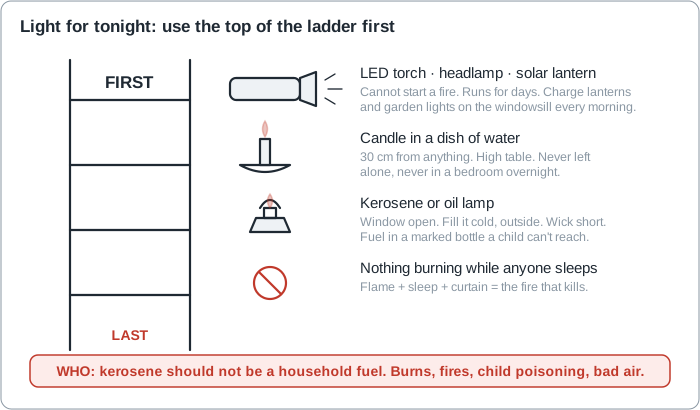
One per person if you can, plus a headlamp for whoever is cooking. Keep the spare batteries out of the torches; old batteries leak and ruin them. Candles are a last resort: in a dish or jar, 30 cm from anything that burns, and never while anyone is asleep.
An FM radio, battery or wind-up
When the mobile network and broadband fail, radio keeps going: stations have generators and a duty to stay on air. Write your BBC local station and national frequencies on a card and tape it to the radio, then tune to each once so you know you can find them. Listen at set times, morning, midday and evening, and switch off in between to save batteries.
A charged power bank
A 10,000 mAh power bank from a known maker charges most phones two or three times. Top it up every few months so it is full when you need it. In a power cut, put the phone in low-power mode and turn the brightness down, and it lasts days instead of one.
Cash, a mix of coins and notes
Card machines and cash machines stop when the power does. The shops that stay open take cash, and they can't change a £50 note. Keep enough small notes and coins for food, a taxi or bus fare and a few days of basics, in an envelope with your document copies.
Copies of ID and documents
Passport, driving licence, insurance policies, a list of medicines and important numbers, in a waterproof bag. Phones die; paper doesn't.
First-aid kit and medication
If anyone in the house takes a daily medicine, this matters more than anything else on the list. Keep a few days extra, with a written list of names and doses. Ask your GP or pharmacist about timing repeat prescriptions so you never run down to the last strip.
Blankets, hygiene items, baby and pet supplies
Blankets, because most home heating stops when the power does. Hygiene: soap, hand sanitiser, toilet roll, sanitary products, bin bags. Ready-to-feed baby formula, which needs no clean water, and food and water for pets.
The Priority Services Register
The other step the campaign asks for is to check whether you can join the Priority Services Register. Energy and water companies use it to find people who need extra help in an outage. If you or someone you care for is of pensionable age, has a health condition or reduced mobility, relies on power or water for medical reasons, or has young children, look at thepsr.co.uk. It is free in England, Scotland and Wales; Northern Ireland has its own Care Register.
Four things I'd add
- A battery carbon monoxide alarm. In every long power cut, someone runs a generator, a barbecue or a camping stove indoors for warmth. Three members of one family in Galicia died, apparently from a generator's fumes, during the Iberian blackout. Carbon monoxide has no smell.
- A plan for the toilet. If the water stops, so does the flush. Two buckets with lids, bin bags and a bag of sawdust or cat litter. See the emergency toilet guide.
- A bottle of plain bleach. Unscented. Two drops per litre makes clear water safe to drink after 30 minutes, when the stored water runs out.
- Phone numbers on paper. Most of us know about three by heart. Write down twenty, and agree one person outside the area that everyone calls, and one place to meet.
Don't buy it all at once
The checklist's best advice is about cost: check your cupboards first, then pick up missing items during your normal shopping to spread the cost, and check the kit every six months. It also suggests donating spare items to people who can't afford to prepare. Most homes already have half of this list. The rest is a few pounds a week for a month. My budget guide has the one-item-a-week method.
Three days, UK
- Water: 3 litres per person per day to drink. 9 litres each, 12 to be comfortable.
- Three days of food you already eat. A tin opener that doesn't plug in.
- Torch each, spare batteries out of the torches. FM radio, frequencies taped on.
- Charged power bank. Cash in coins and small notes. Copies of ID.
- Medicines plus a list. First-aid kit. Blankets. Baby and pet supplies.
- Add: CO alarm, a toilet plan, plain bleach, numbers on paper.
- Check it every six months. Priority Services Register if you need it.
Questions people ask
Is the government warning of something specific?
No. The launch announcement talks about severe weather, including storms and wildfires, that can cut power, water, phones and the internet. The campaign is planned to run for three years and is about everyday resilience, not a particular threat.
What is the Priority Services Register?
A free service in England, Scotland and Wales that tells energy and water companies who may need extra help during an outage: people of pensionable age, people with a health condition or reduced mobility, people who rely on power or water for medical reasons, and households with young children, among others. You register through your local electricity network operator; the Be Ready site links to thepsr.co.uk. Northern Ireland has a separate Care Register.
How much water should I store in the UK?
The Be Ready checklist says bottled water for three days, at 3 litres per person per day for drinking, with more needed for cooking and washing. That is 9 litres each. I would store 12, to cover the cooking and washing.
Why an FM radio?
Because when the mobile network and broadband go down, BBC and local radio keep broadcasting. The checklist asks for a battery or wind-up FM radio. Write your local station's frequency on it today.
Will the Be Ready website give live updates in an emergency?
No. The site says it will not be updated with live information during an emergency. For that, use local radio, the Met Office for weather warnings, and 999 if anyone is in immediate danger.
Sources
- GOV.UK, Households encouraged to take small, simple steps to stay prepared in an emergency (22 October 2026): www.gov.uk/government/news/households-encouraged-to-take-small-simple-steps-to-stay-prepared-in-an-emergency
- UK Government, Be Ready: beready.campaign.gov.uk
- UK Government, Be Ready checklist (PDF): beready.campaign.gov.uk/wp-content/uploads/sites/252/2026/10/Be-Ready-Checklist_English.pdf
- Priority Services Register: www.thepsr.co.uk
- European Commission, Preparedness Union Strategy press release (26 March 2025): ec.europa.eu/commission/presscorner/api/files/document/print/en/ip_25_856/IP_25_856_EN.pdf
