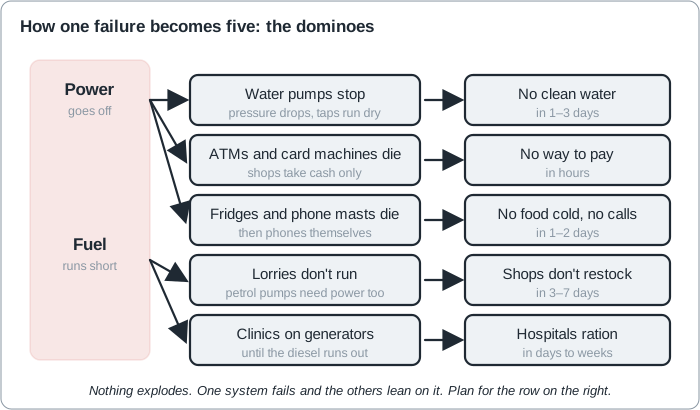
The blackout showed that everything electric stops at once: trains, lifts, traffic lights, phone masts, card machines, cash machines and, in tall buildings, the water. The households that coped had water stored, cash in small notes, a battery radio, torches, a charged power bank and a plan to meet up. The deaths came from medical machines without backup and from a generator and a candle used indoors.
What happened on 28 April 2025
Updated 30 October 2026
At 12:33 Central European time on a Monday, the power systems of mainland Spain and Portugal went down completely. AP reported that Spain lost 15 gigawatts, about 60% of its demand, in five seconds. A small corner of south-west France flickered. ENTSO-E, the body that links Europe's grid operators, later called it the most severe blackout on the European power system in more than 20 years.
Within minutes, trains stopped between stations and the metro stopped in its tunnels; emergency workers rescued around 35,000 passengers, and many spent the night in stations wrapped in Red Cross blankets. AP reported that mobile communications were disrupted and cash machines shut down across the peninsula.
Power came back through the evening and night. By 11am on Tuesday, Red Eléctrica said Spain's system was working normally, and Portugal's REN said all 6.4 million of its customers were reconnected.
It was not harmless. AP, citing the Spanish agency EFE, reported five deaths under investigation in Spain in the first days. Three older members of one family in Taboadela, a small town in Galicia, were found dead at home, where a generator had been running an oxygen machine; emergency workers found a high concentration of carbon monoxide in the house. A woman in Valencia died when her oxygen machine failed. Another died in a fire started by a candle in Madrid.
What caused it
For months there was speculation. The answer, when it came, was dull and technical. ENTSO-E's expert panel published its final report on 20 March 2026 and found no single cause, but "a combination of many interacting factors": oscillations on the grid, gaps in voltage and reactive power control, different voltage-control practices, and power stations in Spain cutting output or disconnecting quickly. Voltage rose fast, more generators tripped off to protect themselves, and the cascade took down the whole system.
For a household, the cause matters less than the lesson: a modern grid can fail all at once, for reasons nobody sees coming, and nobody can tell you on the day how long it will last.
Eight lessons for your home
1. The phone is not a plan
Mobile communications were disrupted across the peninsula, and when phone masts lose power their backup batteries don't last long. Agree now, on paper: one family member outside the area that everyone calls or texts, and one place to meet if you can't reach each other. A school, a relative's flat, the café on the corner. Write it in each person's wallet.
2. A battery radio is how you hear what's going on
With phones and internet gone, radio was the only news. In Portugal, the price-comparison site KuantoKusta reported demand for battery radios up by about 4,600% straight after the blackout, and power banks by about 1,700%. Buy before, not after. A cheap AM/FM radio on AA batteries does the job, with your national broadcaster's frequency taped on the back.
3. Cash, in small notes
Cash machines shut down, and card terminals need power and a network too. A shop that stays open in a blackout can only take cash, and soon runs out of change. Keep a modest amount in coins and small notes at home. The Dutch government suggests €70 per adult and €30 per child.
4. Water stops in tall buildings
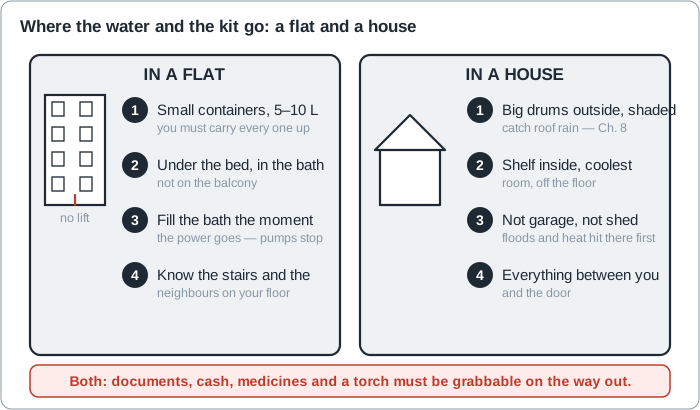
Flats above a few storeys rely on electric pumps to push water up. When the power goes, the taps on the upper floors can run dry within hours, and the lift stops too, so every litre has to be carried up the stairs. Fill the bath and every pot the moment the power goes, and keep stored water in containers you can lift: 5 and 10 litre bottles, not one big drum. The water guide has the sums.
5. Nothing that burns goes indoors
The Galicia family is the hardest lesson. A generator, a barbecue, a camping stove or a charcoal heater makes carbon monoxide, which has no colour and no smell, and kills people asleep in their beds. The CDC's rule: a generator goes outside, more than 6 metres (20 feet) from any window, door or vent, never in a house, basement or garage even with the doors open. Put a battery carbon monoxide alarm near the bedrooms. More in generator safety and carbon monoxide.
6. Torch first, candle last
The Madrid death was a candle. In a blackout, candles come out of drawers all over a city at once. Use torches, headlamps and battery lanterns first. If you light a candle, stand it in a dish of water or a jar, 30 cm from anything that burns, and blow it out before anyone sleeps.
7. If someone depends on a machine, plan for it now
Oxygen concentrators, home ventilators, dialysis, powered beds, insulin in the fridge. Ask the supplier today how long the backup battery lasts and what to do if it runs out, and keep the hospital's number on paper. In the UK, join the Priority Services Register; elsewhere, ask your energy company whether it keeps a list of medical-needs customers. The Be Ready guide explains it.
8. Be ready to be stuck away from home
The blackout started at lunchtime, on a working day. Tens of thousands were on trains and metros; many more were at work, miles from home, with no phone and no transport. Keep a small kit in your work bag: a power bank, a little cash, a bottle of water, a snack, and the family meeting plan on paper. Comfortable shoes in the office drawer are not a bad idea either.
Not the only one
A grid-wide blackout is rare. Long local ones are not. In January 2026, a deliberate fire on a cable bridge in south-west Berlin cut power to about 45,000 households and 2,200 businesses in winter, heating included, and it took around four days to restore everyone. Storms take out power for days somewhere in Europe every year.
That is why the EU now asks every household to be able to manage for at least 72 hours, and why the UK launched its own campaign in October 2026. The EU 72-hour kit guide has the list.
When the grid goes
- Fill water first, while the taps still run. Bath, pots, bottles.
- One contact outside the area, one meeting place. On paper.
- Battery radio, frequencies taped on. Listen at set times.
- Cash in coins and small notes. Charged power bank.
- Torch first, candle last, nothing burning while you sleep.
- Generator, barbecue, camping stove: outside only. CO alarm by the bedrooms.
- Medical machine at home? Ask about the backup battery today.
Questions people ask
What caused the Iberian blackout?
ENTSO-E's expert panel, in its final report of 20 March 2026, found no single cause. It blamed a combination of many interacting factors, including oscillations, gaps in voltage and reactive power control, differing voltage regulation practices, and rapid generator disconnections in Spain, which caused fast voltage rises and a cascade.
How long did the Spain and Portugal blackout last?
It began at 12:33 CEST on Monday 28 April 2025. Red Eléctrica said the Spanish system was functioning normally by 11am on Tuesday, and Portugal's REN said power had been restored to all 6.4 million customers. For most homes it was dark for the evening and night.
How many people died in the Iberian blackout?
AP, citing Spain's EFE news agency, reported five possible blackout-related deaths in Spain in the first days: three members of one family in Galicia from suspected carbon monoxide from a generator, a woman in Valencia whose oxygen machine failed, and a woman in a candle fire in Madrid. Later counts varied.
Could it happen in the UK or elsewhere in Europe?
ENTSO-E calls it the most severe blackout on the European power system in over 20 years, which tells you it is rare. But smaller, longer outages happen every winter from storms, and in January 2026 a fire on a cable bridge in Berlin cut power to about 45,000 households for around four days. Preparing for three days covers both.
What sold out after the blackout?
In Portugal, the price-comparison site KuantoKusta reported demand for battery-powered radios up by about 4,600% and power banks by about 1,700% straight after the blackout. People wanted news and a phone charge.
Sources
- ENTSO-E, 28 April 2025 Iberian blackout (factual report 3 Oct 2025; final report 20 March 2026): www.entsoe.eu/publications/blackout/28-april-2025-iberian-blackout
- AP via Yahoo News, Spain and Portugal restore power; the outage's cause remains a mystery (29 April 2025): www.yahoo.com/news/spain-portugal-scramble-restore-electricity-041250461.html
- The Local Spain, Three deaths in Spain linked to generator use during blackout (30 April 2025): www.thelocal.es/20250430/today-in-spain-a-roundup-of-the-latest-news-on-wednesday-28
- Lisboa Secreta, High demand for battery-operated radios (2 May 2025): lisboasecreta.co/en/high-demand-for-battery-operated-radios
- Wikipedia, 2026 attack on the Berlin power grid (summary of Die Zeit and other reports): en.wikipedia.org/wiki/2026_arson_attack_on_the_Berlin_power_grid
- CDC, About carbon monoxide poisoning: www.cdc.gov/carbon-monoxide/about/index.html
