Outdoors only. At least 20 feet from any window, door or vent. Exhaust pointed away. Never in a garage, basement, shed, carport or on a porch, even with the doors open. Battery carbon monoxide alarms near every bedroom. If several people feel sick, dizzy or headachy at once, everyone goes outside now.
When Hurricane Isaias came ashore near Destin, Florida, on October 9, about 800,000 customers lost power across Florida and Alabama. That's when the generators come out of garages all over the region, and when one of the quietest killers in any outage starts its work.
It happens everywhere the grid fails. In the Iberian blackout of April 2025, three members of one family in Galicia, Spain, were found dead beside a generator that was running a medical machine; investigators suspected carbon monoxide. Careful people, with a good reason to run it. The generator was in the wrong place.
The CPSC counts nearly 100 deaths a year in the US from portable-generator carbon monoxide alone. The CDC puts all non-fire carbon monoxide deaths at more than 400 a year, with more than 100,000 emergency-room visits. Nearly every one of them is preventable with the rules on this page.
Why an open door doesn't help
A generator's exhaust is the same gas as a car's, made faster. Carbon monoxide has no color and no smell. In a closed or half-closed space it builds up faster than an open door or window can clear it. The CDC is blunt: never run a generator inside a home or garage, "even with doors and windows open."
People who are asleep, or who have been drinking, can die before they notice a single symptom. That's why the generator that's "only on overnight to keep the freezer cold" is the most dangerous one of all.
Where the generator goes
- Outside, in the openNot in the garage, the basement, a shed, a carport, or on a covered porch. The CPSC names every one of those.
- At least 20 feet (6 m) from the houseFrom any window, door or vent, yours and your neighbor's. Pace it out once: 20 feet is seven or eight big steps, further than most people think.
- Exhaust pointing awayTurn the generator so the exhaust faces away from every building, and check where the wind is taking it.
- On a heavy outdoor extension cordA cord rated for outdoor use and for the load, fully uncoiled. A thin indoor cord heats up and can melt or start a fire.
- Dry, and cool before refuelingKeep it out of rain and standing water. Switch it off and let it cool before you add fuel. Gasoline on a hot engine is a fire.
Carbon monoxide alarms
If you buy one thing because of this page, buy a carbon monoxide alarm that runs on batteries or has battery backup. A plug-in alarm with no battery is useless in exactly the outage when you need it.
- One near every sleeping area (CDC), and one on every level of the house (CPSC)
- Test it monthly (CPSC); check the batteries at the spring and fall clock changes (CDC)
- Replace the alarm every five years (CDC)
- If it sounds, everyone outside into fresh air, then call 911 or the fire department from outside
The symptoms, and the giveaway
The CDC lists headache, dizziness, weakness, upset stomach, vomiting, chest pain and confusion. It looks like flu. The giveaway is a pattern:
- Several people in the same house feeling ill at the same time
- A headache that eases outside and comes back when you go back in
- Symptoms that started after the generator, heater or grill came on
Any of those: get everyone out into the open air now, switch off the source only if you can do it from outside, and call 911. Don't go back in until the fire department says it's clear. Anyone drowsy, confused or unconscious needs emergency care.
"Backfeeding" the house through a wall outlet can fry your wiring. Worse, it sends power back up the line, where it can electrocute the utility workers trying to get your power back on. Plug appliances straight into the generator, and ask a licensed electrician if you want the generator wired to the house properly.
The other things that make carbon monoxide
Generators get the headlines, but in a winter outage the same gas comes from:
- Charcoal grills and camp stoves brought inside to cook or for warmth. Charcoal makes carbon monoxide the whole time it burns, even when it looks clean.
- The gas oven or stove used as a heater. The CDC says it plainly: "Turning on the stove for heat is not safe!"
- A car running in the garage to charge phones or warm up, even with the garage door open.
- Unvented fuel heaters in a closed room.
For staying warm without any of these, see how to stay warm in a power outage.
Fuel: the sums nobody does
A small 1-kilowatt generator burns around a pint of gasoline an hour (about half a liter). A 3-kilowatt one, a quart or more. Run it four hours a day for a week and you need roughly 4 to 8 gallons, and after a big storm the gas stations are closed or out of fuel.
- Run it in bursts. Two hours in the morning and two in the evening to cool the fridge and freezer, pump water and charge every battery in the house. Then switch it off. A generator running all day for one lamp is the most expensive lamp in the world.
- Store gasoline outdoors or in a detached shed, in proper fuel cans, never in the house and never near a flame or the water heater.
- Gas goes stale after a few months and gums up the carburetor. Use it in the car and replace it, or add stabilizer and date the can.
Smaller jobs need no generator
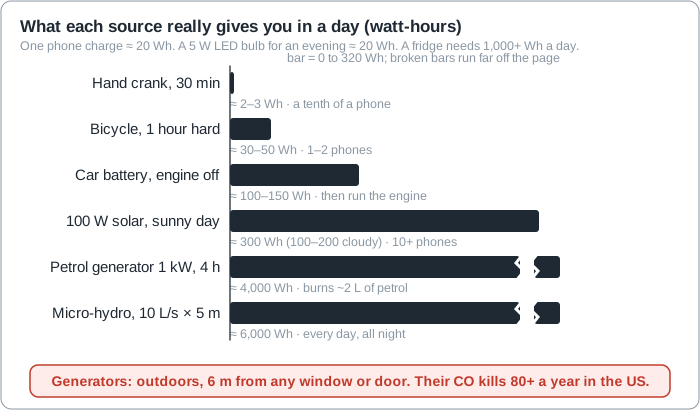
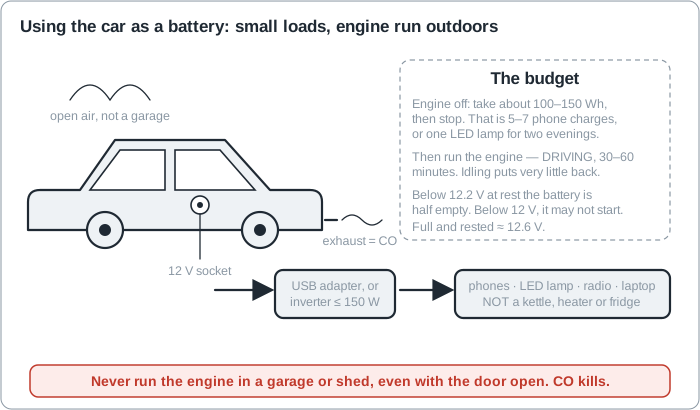
For phones, lights and a radio, you may not need a generator at all. A car's battery runs a USB adapter or a small inverter for phones, a lamp and a radio, as long as the engine runs outdoors in the open, never in the garage. A 100-watt solar panel with a battery does the same with no fumes and no fuel. The drawing below shows the car's safe budget.
Generator
- Outdoors only. Not garage, basement, shed, carport or porch, even with doors open.
- 20 feet (6 m) from any window, door or vent. Exhaust pointed away.
- Battery CO alarm near every bedroom and on every floor. Test monthly.
- Several people sick at once, or better outside: everyone out, call 911.
- Never plug into a wall outlet. Appliances straight into the generator.
- Cool before refueling. Gas stored outside. Run in bursts.
- No grill, camp stove, gas oven or car engine used for heat indoors.
Questions people ask
How far does a generator need to be from the house?
At least 20 feet (6 m) from any window, door or vent, according to the CDC and the Consumer Product Safety Commission, with the exhaust pointed away from your home and your neighbor's. Pace it out once; it's further than most people guess.
Can I run a generator in the garage with the door open?
No. The CDC says never run a generator inside a home or garage, even with doors and windows open. Carbon monoxide builds up in an enclosed space faster than an open door can clear it.
Can I run a generator on a covered porch or under a carport?
No. The CPSC lists porches and carports with garages and basements as places a generator must never run. The roof and walls trap the exhaust against the house.
What are the symptoms of carbon monoxide poisoning?
Headache, dizziness, weakness, upset stomach, vomiting, chest pain and confusion. The CDC describes them as flu-like. The giveaway is several people in the same place feeling ill at once, or feeling better outside. People who are asleep or have been drinking can die before they feel anything.
Where should I put a carbon monoxide detector?
The CDC says near every sleeping area, battery-powered or with battery backup, checked at the spring and fall clock changes and replaced every five years. The CPSC says one on every level of the home, tested monthly.
This page is information, not medical advice. If you suspect carbon monoxide poisoning, get into fresh air and call 911. The distances and alarm advice are the CDC's and the US Consumer Product Safety Commission's; the fuel figures are rough planning numbers from the book, so check your own generator's manual.
Sources
- CDC, About carbon monoxide poisoning: www.cdc.gov/carbon-monoxide/about/index.html
- US Consumer Product Safety Commission, CO poisoning and generator safety (January 2024): www.cpsc.gov/Newsroom/News-Releases/2024/As-Winter-Storms-Continue-CPSC-Urges-Families-to-Take-Steps-to-Prevent-Carbon-Monoxide-Poisoning-and-Fires
- CDC, Stay safe during and after a winter storm: www.cdc.gov/winter-weather/safety/stay-safe-during-after-a-winter-storm-safety.html
- AP via WBUR, Hundreds of thousands without power after Isaias (10 October 2026): www.wbur.org/news/2026/10/10/hundreds-of-thousands-without-power-after-isaias-slams-the-florida-panhandle-and-alabama
- AP via Yahoo News, Spain and Portugal restore power (29 April 2025): www.yahoo.com/news/spain-portugal-scramble-restore-electricity-041250461.html
