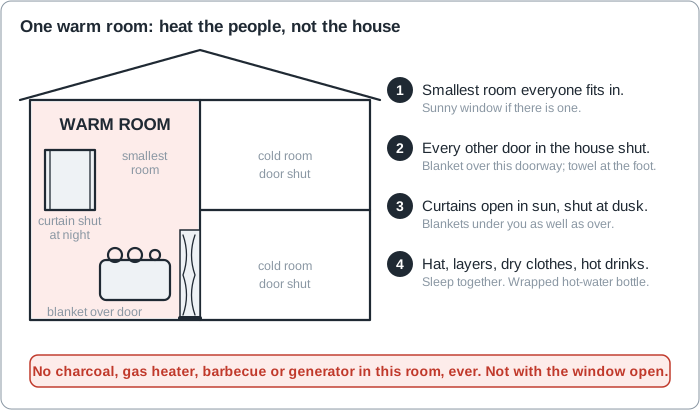
Heat the people, not the house. Pick the smallest room everyone fits in, close every other door, put a towel along the bottom of the door and a blanket over the window at night. Loose layers, a hat and dry socks. Sleep together, with blankets under you as well as over. Hot drinks and hot food. Never the oven, a grill, a camp stove or a generator indoors.
People don't usually freeze in a winter outage. They get slowly cold in a house with no heat, stop thinking clearly, and on the second night somebody brings the charcoal grill inside "just to take the edge off." That's the night that kills people.
A cold house is dangerous in a quiet way. Here is how to keep one room bearable for days, using what's already in the house, and how to tell when someone is getting into trouble.
Make one warm room
You can't heat a whole house without power. You can keep one room livable with the heat of the people in it, if you stop that heat from leaking away.
- Choose the roomThe smallest room everyone fits in. A room with a south-facing window gets free warmth on a sunny day.
- Close off the rest of the houseShut every other door. The CDC's advice is the same: close off rooms you don't need.
- Stop the draftsA rolled towel along the bottom of the door. A blanket hung over the doorway. Tape or towels over any gap you can feel air through.
- Use the windowsCurtains open while the sun is on the glass, closed the moment it goes. At night, cover the windows with blankets or curtains, as the CDC recommends.
- Make the space smaller stillA tent pitched inside the room, or a sheet draped over chairs around the mattress, holds warm air close to the people. Kids love it, which helps.
Dress for it
- Loose layers. Several thin layers beat one thick coat, because the air trapped between them is what keeps you warm. The CDC says several loose layers.
- A hat, indoors, all the time. And something round the neck.
- Dry socks, dry everything. Damp clothes pull heat out of you fast. Change anything that's wet from sweat, snow or spills.
- Gloves if your hands are going numb. Numb fingers drop things and burn easily.
Sleep warm
Night is when the house is coldest and people are least able to notice they're getting cold.
- Everyone in the one room. Kids in with parents, blankets shared. A few bodies in a small closed room make a real difference.
- Blankets under you as well as over. A cold floor or a thin mattress steals heat from below faster than the air above. A camping mat or a folded comforter under the bedding helps.
- Sleeping bags if you have them, on top of the bed, with a blanket over.
- A hot water bottle in the bed ten minutes before you get in. Wrap it in a towel. Never boiling water, never against bare skin, and never for a baby who can't push it away.
Eat, drink and move
A cold body burns food to stay warm. Eat regular meals, and something hot if you can heat it safely. Hot sweet drinks help, and the CDC recommends warm, non-alcoholic drinks for someone who's cold.
Alcohol feels warm and isn't: it opens the blood vessels in your skin, and you lose heat faster. Ten minutes of brisk movement every hour or two, carrying, sweeping, a walk up and down the stairs, warms you for a while after. Then rest, because sweating in the cold makes you colder.
No gas oven or stove for heat. The CDC: "Turning on the stove for heat is not safe!" No charcoal grill, camp stove, kerosene heater in a closed room, or generator inside the house, garage, basement or porch, even with a door open. They make carbon monoxide, which you can't see or smell, and which kills people in their sleep. Put a battery carbon monoxide alarm near the bedrooms. If several people get headaches or feel dizzy and sick at once, everyone goes outside. More on this in generator safety and carbon monoxide.
A wood stove or an open fireplace with a working chimney is different: use it, keep the flue open, and keep a carbon monoxide alarm in the room.
Light without burning the house down
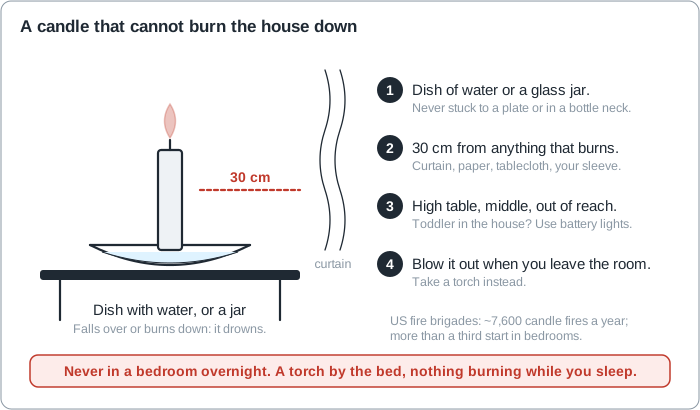
The dark makes a cold house feel colder, and candles come out of drawers all over town. US fire departments count thousands of house fires started by candles every year, and more than a third of them begin in bedrooms. Flashlights and battery lanterns first. If you do light a candle, stand it in a dish of water or a jar, 12 inches (30 cm) from anything that burns, and blow it out before anyone sleeps.
Watch the ones who can't tell you
Older people and babies get cold first and complain last. An older person may not shiver at all; a baby may just go quiet.
| Hypothermia | Frostbite | |
|---|---|---|
| Signs | Shivering, exhaustion, confusion, fumbling hands, memory loss, slurred speech, drowsiness. Babies: bright red, cold skin, very low energy. | Numbness; white or grayish-yellow skin; skin that feels firm or waxy. |
| Do | Get them into the warm room and out of wet clothes. Wrap them, head included. Warm the chest, neck, head and groin first. Warm, non-alcoholic drinks if they're awake enough to swallow. | Get them warm. Don't rub the area and don't use a heating pad, a fire or a stove to warm it; numb skin burns easily. |
| When it's an emergency | Body temperature below 95°F, confusion, or someone hard to wake. Call 911. | Skin that stays hard, pale or blistered. Get medical care. |
No hot bath and no rubbing for someone who's very cold. Hold them close and warm them slowly. If the house can't be kept warm and there's a baby, an older person or someone sick in it, go to a warming center or a relative's house early, while the roads are still open.
Before the next cold snap
- A battery carbon monoxide alarm outside the bedrooms
- A sleeping bag or warm blanket for each person (Ready.gov lists one per person)
- Hats, gloves and wool socks in one box
- Flashlights, a headlamp and spare batteries, kept out of the devices
- A hot water bottle or two
- A camping stove for cooking outdoors only, and food that needs little cooking
- Water stored: see how much water to store per person
The full list for the season, including the car and the pipes, is in the winter storm checklist.
Cold house
- One warm room: the smallest one. Other doors shut, towel under the door, blanket over the window at night.
- Loose layers, a hat, dry socks. Change anything damp.
- Sleep together. Blankets under you as well as over. Wrapped hot water bottle.
- Eat regularly, warm sweet drinks, no alcohol. Move a little every hour.
- No oven, grill, camp stove or generator indoors for heat. Ever.
- Confused, slurring, drowsy or below 95°F: wrap, warm the trunk first, call 911.
Questions people ask
How long can a house stay warm without power?
It depends on the insulation, the outside temperature and how tightly you close it up, so nobody can give one number. What you control is how fast it loses heat: keep doors shut, block drafts, close curtains at night, and live in one small room so the heat you have goes further.
Is it safe to use a gas oven or stove for heat?
No. The CDC says turning on the stove for heat is not safe. Gas ovens and burners, charcoal grills, camp stoves and generators make carbon monoxide, which has no smell and kills people in their sleep.
Can I use candles to keep warm?
Candles give very little heat and start thousands of house fires a year. Use them only for light, in a dish of water or a jar, 12 inches (30 cm) from anything that burns, and never while anyone is asleep.
What are the signs of hypothermia?
Shivering, exhaustion, confusion, fumbling hands, memory loss, slurred speech and drowsiness. In babies, bright red, cold skin and very low energy. The CDC says a body temperature below 95°F is a medical emergency.
Should I go to a warming center?
If your home can't be kept safely warm, especially with a baby, an older person or someone sick in the house, yes. Your local news, radio or city website will list warming centers during a big outage. Go before anyone is showing signs of hypothermia, not after.
This page is information, not medical advice. If someone is very cold and confused or hard to wake, call 911. The hypothermia and frostbite signs are the CDC's and Ready.gov's; the candle-fire figures are the US National Fire Protection Association's, as given in the book.
Sources
- CDC, Stay safe during and after a winter storm: www.cdc.gov/winter-weather/safety/stay-safe-during-after-a-winter-storm-safety.html
- CDC, Preventing hypothermia and frostbite: www.cdc.gov/winter-weather/prevention/index.html
- Ready.gov (FEMA), Winter weather: www.ready.gov/winter-weather
- CDC, About carbon monoxide poisoning: www.cdc.gov/carbon-monoxide/about/index.html
