Before the storm: several days of water, no-cook food and medicine, flashlights and batteries, a battery radio, a carbon monoxide alarm, a warm sleeping bag or blanket for each person, cash, and a car kit with a full tank. When the power goes: one warm room, the fridge shut, and nothing that burns inside the house. The checklist is below.
What this winter looks like
Updated 30 October 2026
NOAA's winter outlook, issued on October 15, is dominated by a strong El Niño. NOAA expects it to push the jet stream south and east, which tilts the odds toward a stormier, wetter winter across the southern tier, from the Southwest to the Southeast, and along the East Coast. Much of the north and east leans warmer than usual. The outlook doesn't forecast snowfall or single storms, and NOAA updates it on November 19.
A wetter South in winter is the setup for ice, and ice is what brings the lines down. Last January a storm stretching from the southern Plains to New England left close to a million customers without power at its peak. In Nashville, about 230,000 Nashville Electric Service customers lost power; it took the utility until February 6, nearly two weeks, to restore almost all of them.
The grid itself is stretched in a long cold snap. NERC's assessment for last winter found that every region had enough supply for a normal peak, but several, including New England, parts of the Southeast and Texas, could fall short in a wide, prolonged freeze. None of that is a reason to panic. It's a reason to get the house ready on a dry weekend in November instead of in a supermarket line the night before.
The home checklist
Ready.gov's advice is to have supplies in case you need to stay home for several days without power. I plan for two weeks, because that's what the bad ones run to.
Water and food
- Water: at least 1 gallon per person per day. A family of four, three days: 12 gallons. Two weeks: 56. (The full table)
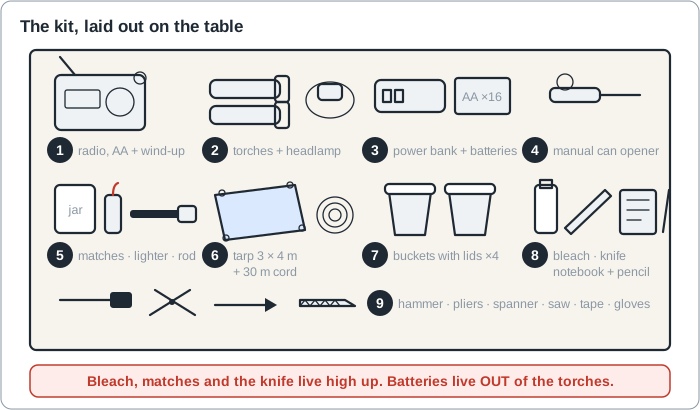
- A bottle of plain unscented bleach to treat more
- Food that needs no cooking or very little: peanut butter, crackers, canned fish and beans, oats, dried fruit
- A manual can opener
- Appliance thermometers in the fridge and freezer, and jugs of water frozen in the freezer's gaps (why)
- Food, water and medicine for pets
Warmth
- A sleeping bag or warm blanket for each person
- Hats, gloves, wool socks and a change of dry clothes, in one box
- A hot water bottle or two
- Towels or draft stoppers for the doors of the warm room
- Drafts sealed where you can: Ready.gov suggests insulation, caulking and weather stripping
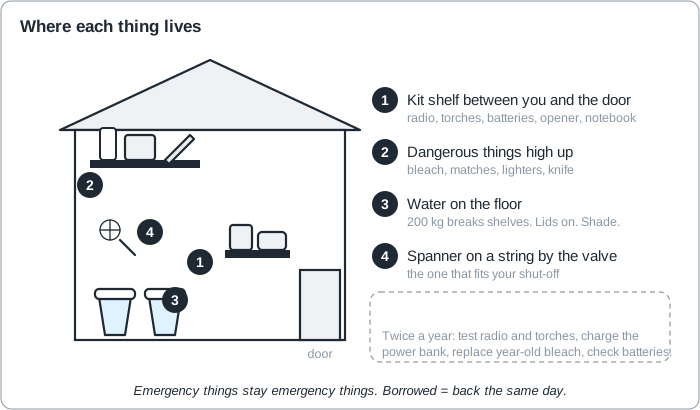
- Learn how to keep your pipes from freezing and where your water shut-off valve is
Light, power and news
- A flashlight per person and a headlamp, with spare batteries stored outside the devices
- A battery or hand-crank radio, plus a NOAA Weather Radio with tone alert (both on Ready.gov's list)
- Phone chargers and a charged power bank
- Battery carbon monoxide alarms on every level of the house, and tested smoke alarms
- If you own a generator: a spot picked 20 feet from the house, a heavy-duty outdoor cord, and fuel stored outside (the rules)
Health and paper
- At least a week of every daily medicine, and a written list of them
- A first-aid kit
- Cash in small bills: card readers and ATMs stop when the power does
- Copies of ID and insurance in a waterproof bag
- Important phone numbers written on paper
- A plan for anyone who depends on power for a medical device: ask the supplier now about backup batteries, and ask your utility whether it keeps a list of medical-needs customers
The car checklist
From Ready.gov's winter list:
- Jumper cables
- Sand for traction
- A flashlight
- Warm clothes and blankets
- Bottled water and non-perishable snacks
- A full tank of gas
Under a winter storm warning, Ready.gov's advice is to stay off the roads. If you get stuck in the car, stay inside it. Never run the car to warm up or charge phones inside a garage, even with the door open.
When the power goes
- Check everyoneIs anyone hurt, cold, or relying on a machine that needs power? Older neighbors living alone go on this list too.
- Fill waterIf the tap still runs, fill pots, bottles and the bathtub. If you're on a well with an electric pump, you won't have this chance, which is why you stored water.
- Shut the fridgeWrite down the time. Four hours for the fridge, 48 for a full freezer.
- Set up the warm roomThe smallest room everyone fits in, other doors shut, towels at the door, blankets over the windows at night. How to stay warm in a power outage has the details.
- Turn on the radioListen at set times, morning, midday and evening, and switch off in between to save batteries.
- Save the phoneLow-power mode, screen dimmed, one message to family saying where you are.
Nothing that burns goes indoors for heat. Not the gas oven or stovetop, not a charcoal grill, not a camp stove, not a generator in the garage or basement. Ready.gov and the CDC say the same thing. Carbon monoxide has no smell and kills people in their sleep in every winter outage. And keep checking on the oldest and youngest. Shivering, confusion, slurred speech or drowsiness, or a body temperature below 95°F, is an emergency.
After the storm
- Treat every downed line as live. Stay well away and report it to the utility.
- Shovel slowly. Ready.gov warns that overexertion while shoveling can bring on a heart attack.
- Check the food before you eat it: fridge thermometer at 40°F or below, freezer food still with ice crystals. When in doubt, throw it out.
- Restock the shelf the following week, while you still remember what you ran out of.
Ice storm, lines down
- Several days minimum, two weeks if you can: water, no-cook food, medicine.
- Flashlights, radio, power bank, CO alarm, a sleeping bag each, cash.
- Car: cables, sand, flashlight, blankets, water, snacks, full tank.
- Power out: fill water, shut the fridge, one warm room, radio at set times.
- Nothing that burns indoors for heat. Generator 20 feet out.
- Check the old and the young. Below 95°F or confused = 911.
Questions people ask
What's the difference between a winter storm watch and a warning?
A watch means a storm is possible, so finish getting ready. A warning means it is expected or happening. Ready.gov's advice under a winter storm warning is to find shelter right away and stay off the roads.
Will this winter be bad?
NOAA's outlook, issued October 15, 2026, leans toward a stormier, wetter winter across the southern tier and up the East Coast because of a strong El Niño, and warmer than average across much of the north and east. It doesn't forecast snowfall or individual storms. The next update is November 19.
How many days of supplies should I have for a winter storm?
Ready.gov says to have supplies in case you need to stay home for several days without power. The CDC suggests trying for two weeks of water. Last January, some Nashville homes waited almost two weeks for power, so I plan for two.
What should I keep in my car in winter?
Ready.gov's list: jumper cables, sand, a flashlight, warm clothes, blankets, bottled water and non-perishable snacks, and keep the tank full. If you are stuck in your car in a storm, stay inside it.
Is shoveling snow dangerous?
It can be. Ready.gov warns against overexertion when shoveling because of the risk of heart attack. Take it slowly, take breaks, and let someone younger and fitter do the heavy part if you can.
This page is information, not medical advice. The checklist items follow Ready.gov and the CDC; the outlook is NOAA's as of October 15, 2026, and may change at its November update.
Sources
- NOAA, El Niño looms large over U.S. winter outlook (15 October 2026): www.noaa.gov/news-release/el-nino-looms-large-over-us-winter-outlook
- Ready.gov (FEMA), Winter weather: www.ready.gov/winter-weather
- Ready.gov (FEMA), Build a kit: www.ready.gov/kit
- CDC, Stay safe during and after a winter storm: www.cdc.gov/winter-weather/safety/stay-safe-during-after-a-winter-storm-safety.html
- Cotality, Major January winter storm impacts large portion of the nation (January 2026): www.cotality.com/hazard-hq/major-january-winter-storm-impacts-large-portion-of-the-nation
- WSMV, Nashville Electric Service nearly restores power after winter storm (7 February 2026): www.wsmv.com/2026/02/07/nashville-electric-service-give-update-they-nearly-restore-power-all-customers-following-winter-storm-fern
- NERC, 2025–2026 Winter Reliability Assessment: prod.nerc.com/globalassets/our-work/assessments/nerc_wra_2025.pdf
