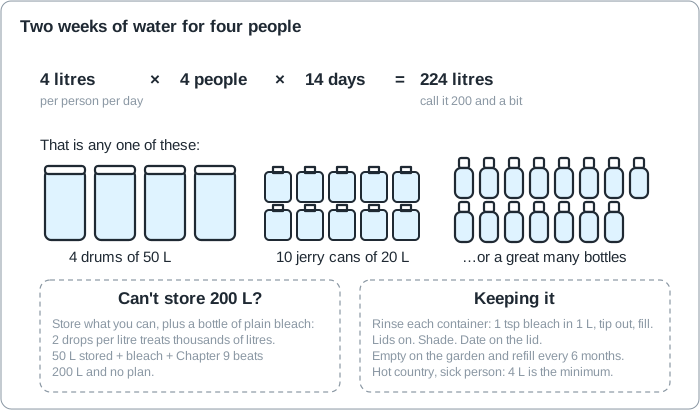
At least 1 gallon (about 4 liters) per person, per day. Store 3 days' worth as a minimum and 2 weeks' worth if you can. For one person that is 3 gallons and 14 gallons. Store more for hot weather, pregnancy, illness, babies on formula and pets.
Water is the first thing you'll miss and the hardest thing to get once it's gone. Food you can stretch for a week. Water, you can't go without for more than a few days, and in summer heat it's less.
The good news is that the sum is simple, the containers are cheap, and the water itself costs almost nothing. The part people get wrong is the total. A gallon a day sounds small until you multiply it out for a family and fourteen days and see it stacked in a corner.
The family table
One gallon per person per day: roughly half a gallon to drink and half for cooking, brushing teeth, washing hands and cleaning a cut.
| Household | 3 days | 2 weeks |
|---|---|---|
| 1 person | 3 gal (11 L) | 14 gal (53 L) |
| 2 people | 6 gal (23 L) | 28 gal (106 L) |
| 4 people | 12 gal (45 L) | 56 gal (212 L) |
| 6 people | 18 gal (68 L) | 84 gal (318 L) |
For a family of four, two weeks is about 56 gallons: one 55-gallon drum, or eleven 5-gallon jugs, or a great many cases of bottles. It looks like a lot until you see it in place, and then it looks like what it is, two weeks of not worrying.
What the agencies say, side by side
You'll see different numbers on different websites. They mostly agree on the amount and disagree on how many days. Here they are as each agency puts it:
| Who | Per person per day | How long |
|---|---|---|
| CDC (US) | At least 1 gallon | 3 days minimum; "try to store a 2-week supply if possible" |
| Ready.gov / FEMA (US) | 1 gallon | "Several days" |
| UK government (Be Ready, 2026) | 3 liters for drinking, more for cooking and washing | 3 days |
| Netherlands | 3 liters | 72 hours |
| Sweden (MCF) | 3 to 5 liters | At least a week |
| Germany (BBK) | 2 liters (1.5 to drink, 0.5 to cook) | Ideally 10 days |
| My book | 4 liters (just over a gallon) | 2 weeks |
So the US gallon and my four liters are the same advice, give or take a cup. The European figures that look lower usually count drinking water only. Germany's 2 liters a day assumes you still have some tap water for washing; I wouldn't plan on that.
Where I part company with "several days" is the length. Most outages are over in a few days, but the bad ones, an ice storm, a hurricane, a broken water main in a heat wave, run a week or two. Two weeks is the biggest number most people will actually store, and it covers nearly everything short of a catastrophe.
When one gallon isn't enough
- Heat. Ready.gov says very hot weather can double what a person needs to drink. In a summer outage, plan on 2 gallons a day.
- Pregnancy, breastfeeding, illness. The CDC says store more for these. Diarrhea and fever pull water out of the body fast.
- Babies on formula. They need clean water for every bottle, and the bottles need washing. Ready-to-feed formula saves water in an emergency.
- Pets. Store extra. Measure what yours drinks on a hot day.
- Flushing. A gallon a day does not flush a toilet. If the water is off, the two-bucket toilet saves your stored water for drinking.
Don't ration drinking water. Drink what your body needs today and work on finding more tomorrow. Someone who cuts back to stretch the supply gets slow, muddled and ill. Ration the washing, not the drinking.
How to store it
- Pick food-grade containersStore-bought bottled water, 5-gallon water jugs, water-storage drums, or washed soda bottles with screw caps. Never anything that held fuel, bleach, pesticide or other chemicals, however well you wash it; it soaks into the plastic. Glass breaks.
- Sanitize themWash with soap and rinse. Then swish a solution of 1 teaspoon of unscented liquid bleach in a quart of water around the inside, pour it out, and let it air-dry. (That is the Ready.gov method.)
- Fill from a treated tapCity tap water is already disinfected. Cap tightly and write "DRINKING WATER" and the date on each one.
- Keep it cool and darkThe CDC says 50 to 70°F, out of direct sunlight, and away from gasoline, paint and pesticides, whose fumes can get through plastic. Under beds, in a closet, under the stairs.
- Replace every 6 monthsWater you bottled yourself gets poured on the garden and refilled twice a year. Store-bought bottles keep until their expiration date. Put old ones in front.
Apartments: many smaller containers beat one big drum. You can lift a 2.5-gallon jug up the stairs; you can't move a 55-gallon drum at all, and a balcony wasn't built for over 450 pounds of water.
The water you already have
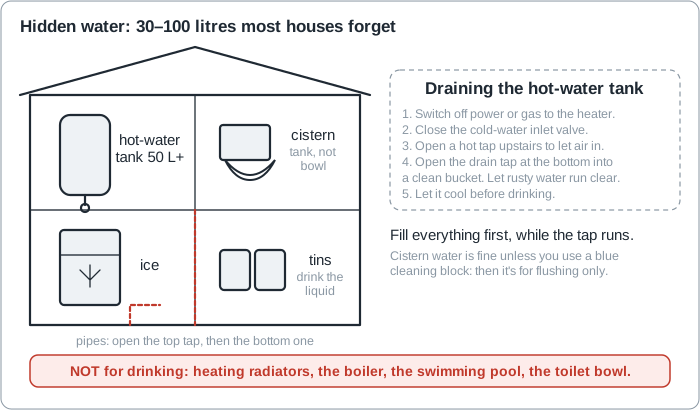
When the tap is still running at the start of an outage, fill every clean pot, bottle and the bathtub. The water in the pipes right now is clean. What comes later, if the pumps lose pressure, may not be. After that, most houses still hide water nobody thinks of:
- The water heater tank, if you have the big cylinder kind: 13 gallons (50 liters) at the very least, and usually much more. Turn off the power or gas first, close the cold-water inlet, open a hot tap upstairs to let air in, then drain from the valve at the bottom. Let the first rusty bit run off.
- The toilet tank (the cistern, not the bowl), unless you use a blue cleaning tablet. If you do, it's for flushing only.
- Ice in the freezer, and the liquid in canned fruit and vegetables.
Never drink from the heating radiators or boiler, which are full of rust and chemicals. Pool and fish-tank water is for washing and flushing only.
Store less, if you know how to treat more
If you can't fit two weeks of water, store what you can and keep a bottle of plain, unscented household bleach. The EPA's dose for 6% bleach is 8 drops per gallon of clear water; double it for cloudy or very cold water, stir, and wait 30 minutes. One bottle treats thousands of gallons. Boiling works too: a rolling boil for one minute. The water purification guide has both methods with drawings, and the boil-water notice guide covers what to do when the city tells you the tap isn't safe.
Twelve gallons stored and a bottle of bleach is worth more than fifty-six gallons and no idea what to do when it runs out.
Water to store
- 1 gallon (4 L) per person per day. More in heat, pregnancy, sickness.
- Family of four: 12 gallons for 3 days, 56 gallons for 2 weeks.
- Food-grade containers, sanitized, dated. Cool, dark, away from fuel.
- Replace self-filled water every 6 months.
- Outage starts: fill the tub and every pot while the tap runs.
- Hidden water: heater tank, toilet tank, ice, cans.
- Bleach: 8 drops per gallon, 30 minutes. Don't ration drinking.
Questions people ask
How much water should I store for a family of 4?
At one gallon per person per day: 12 gallons (about 45 liters) for three days, and 56 gallons (about 212 liters) for two weeks. Add more for hot weather, for anyone pregnant or sick, and for pets.
Is one gallon a day really enough?
For drinking plus basic cooking and hand-washing, yes, just. It does not cover flushing toilets, bathing or laundry. Ready.gov notes that hot weather can double what a person needs to drink. Treat one gallon as the floor, not the target.
How long does stored tap water last?
Water you bottle yourself from a treated tap should be replaced every six months, according to the CDC and Ready.gov. Store-bought bottled water keeps until its expiration date. Write the date on every container.
Where is the best place to store emergency water?
Somewhere cool and dark: the CDC says 50 to 70°F, out of direct sunlight, and away from gasoline, paint and pesticides. A closet, under beds or under the stairs. Not in a hot garage next to the lawn mower fuel, and keep some by the door you would leave through.
How much water does a dog or cat need in an emergency?
The CDC says to store extra for pets but gives no figure. Measure what your pet drinks on a normal hot day and store that amount for each day of your plan.
Sources
- CDC, Creating and storing an emergency water supply: www.cdc.gov/water-emergency/about/how-to-create-and-store-an-emergency-water-supply.html
- Ready.gov (FEMA), Water: www.ready.gov/water
- US EPA, Emergency disinfection of drinking water: www.epa.gov/ground-water-and-drinking-water/emergency-disinfection-drinking-water
- UK Government, Be Ready checklist (October 2026): beready.campaign.gov.uk/wp-content/uploads/sites/252/2026/10/Be-Ready-Checklist_English.pdf
- Rijksoverheid (Netherlands), Wat zit er in een noodpakket?: www.rijksoverheid.nl/vraag-en-antwoord/veiligheidsregios-en-crisisbeheersing/wat-zit-er-in-een-noodpakket
- MCF (Sweden), Access to water during a crisis: www.mcf.se/en/advice-for-individuals/home-preparedness--prepping-for-at-least-a-week/access-to-water-during-a-crisis
- BBK (Germany), Bevorraten: www.bbk.bund.de/DE/Warnung-Vorsorge/Vorsorge/So-koennen-Sie-sich-vorbereiten/Bevorraten/bevorraten_node.html
