The EU wants every household able to look after itself for at least 72 hours if the power, water, shops or phones stop. For your home that means: about 3 litres of water per person per day, three days of food that needs no fridge, your medicines, a battery or wind-up radio, torches and batteries, a charged power bank, some cash and copies of your documents, kept together where everyone can find them.
What the EU actually said
Updated 30 October 2026
On 26 March 2025 the European Commission published its Preparedness Union Strategy: 30 key actions to get the EU and its governments ready for "emerging threats and crises" of every kind. Most of it is about governments: a crisis hub, stockpiles of critical equipment, EU-wide exercises.
One line is about you. The Commission will "encourage the public to adopt practical measures, such as maintaining essential supplies for a minimum of 72 hours in emergencies." It also proposed putting preparedness into school lessons and holding an EU Preparedness Day.
What the strategy did not do is give you a list. As of late October 2026 I could find no official EU-wide household kit list or published 72-hour guidelines. The detail is coming country by country instead. The Netherlands launched its "Denk vooruit" (Think ahead) campaign on 3 November 2025, built around 72 hours without water, power or internet. Luxembourg began sending a printed "Guide to 72 Hours of Self-Sufficiency" to every household, about 300,000 copies, from 14 October 2026. The UK, outside the EU, launched its own Be Ready campaign a week later.
Plenty of people feel unready. In the EU's 2024 Eurobarometer survey, almost two-thirds said they needed more information to prepare for emergencies, and almost four in ten said they lacked the time or money.
Why 72 hours?
The press release doesn't explain the number, but it matches what happens in most outages. The first three days are when the shops are cash-only, the phone masts run out of battery, and the water pressure drops in tall buildings. After that, either things are back or the authorities have organised water points, shelters and information.
Seventy-two hours is also a number people will actually do. It is three days of the food you already eat and a few big bottles of water. The Iberian blackout of April 2025 was over in less than a day for most people, and still showed how much stops in the first few hours.
What each country recommends
| Country | How long | Water per person per day |
|---|---|---|
| Netherlands | 72 hours | 3 litres |
| Sweden (MCF) | At least a week | 3–5 litres |
| Germany (BBK) | Ideally 10 days; 3 already helps a lot | 2 litres (1.5 to drink, 0.5 to cook) |
| Finland (72 tuntia) | At least 3 days | No figure; keep containers to store water |
| UK (Be Ready, 2026) | 3 days | 3 litres to drink, more for cooking and washing |
A few details worth borrowing. The Dutch suggest keeping €70 in cash per adult and €30 per child. Sweden's 3–5 litres covers drinking, cooking and basic hygiene. Germany's 2 litres a day comes to 20 litres each for ten days. Finland warns you may need to switch off ventilation and seal windows if told to shelter indoors. The UK says build the kit gradually as you shop.
The differences are mostly about what the water is for. Three litres covers drinking. Once you add cooking, washing hands and a cut, it is nearer four or five, which is why Sweden says 3–5 and my book plans on 4. The water guide has the full table for families.
A 72-hour kit for your home
This is the Dutch government's list, which is the most complete official one I found, merged with the book's. It is a home kit, not a bag for running away; for that, see the go-bag list.
Water and food
- Bottled water: 3 litres per person per day, so 9 litres each. I would make it 12.
- Three days of long-life food you already eat, that needs no fridge and little or no cooking: crackers, tinned fish and beans, peanut butter, muesli, dried fruit, nuts
- A manual tin opener
- Baby food and formula if needed; pet food and water
Light, power and news
- A battery or wind-up radio, with spare batteries
- A torch for each person, and spare batteries kept outside the torch
- A phone with a charged power bank
- Candles and matches, used only in a dish or jar and never while anyone sleeps
Health
- Your daily medicines, at least a few days' extra, and a written list of them
- A first-aid kit
- Hygiene items: soap, toilet paper, wet wipes, sanitary products, nappies
Paper and the rest
- Cash in small notes and coins
- Copies of ID and important documents in a waterproof bag
- Important phone numbers written on paper
- Blankets or sleeping bags
- A whistle, basic tools and spare house and car keys
Where to keep it
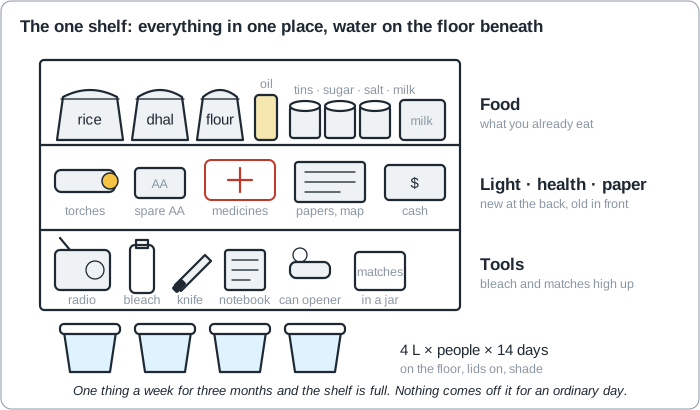
One shelf or one box, between you and the front door, and everyone in the house over ten knows where it is. Water goes on the floor underneath, because 50 litres weighs 50 kilograms. Dangerous things, bleach, matches and knives, go on the top shelf.
The emergency things stay emergency things. The batteries in the kit are not for the TV remote. Check it twice a year; the clock changes in March and October are an easy reminder. Eat the food before it expires and replace it, new at the back, old at the front.
Write the radio frequencies down now
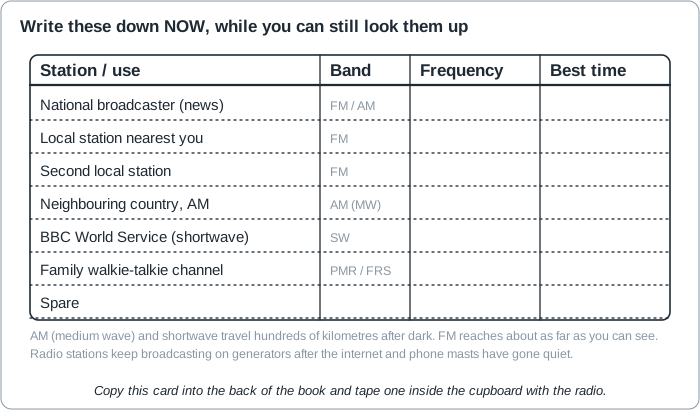
Every national list includes a battery radio, because when the mobile network fails, broadcast radio keeps going on generators. But the night you need a frequency is the night you can't look it up. Write your national broadcaster's FM and AM frequencies and two local stations on a card, tape it to the radio, and tune to each one once so you know it works.
Build it in a month, without spending much
You don't need to buy it all at once, and you shouldn't buy a ready-made "survival bag". The UK government's advice is the right one: check your cupboards first, then pick up what's missing a little at a time during normal shopping. The Dutch say the same about the cash. Most homes already have half the list. My budget guide has the one-item-a-week method and what to buy first.
72 hours on your own
- Water: 3 litres per person per day to drink, 4 to be comfortable. 12 litres each.
- Three days of food you already eat, no fridge needed. Tin opener.
- Radio with batteries, frequencies taped on. Torch each. Charged power bank.
- Medicines and a written list. First-aid kit. Hygiene.
- Cash in small notes. Document copies. Numbers on paper.
- One shelf by the door. Checked when the clocks change.
Questions people ask
Is the EU telling people to stockpile because of war?
The strategy is written for emerging threats and crises in general, not one in particular. The 72-hour advice is the same whatever the cause, because most emergencies, from a storm to a grid failure, mean a few days without power, water, shops or phones.
How much water do I need for 72 hours?
The Netherlands and the UK say 3 litres per person per day for drinking, so 9 litres each for three days. Sweden says 3 to 5 litres a day to cover cooking and basic hygiene too. I plan on 4 litres a day: 12 litres per person, about 50 litres for a family of four.
Is there an official EU emergency kit list?
Not that I could find as of October 2026. The Commission's March 2025 strategy recommends the 72-hour minimum, but the detailed lists come from national governments. The Dutch and UK lists are the clearest.
How much cash should I keep at home?
The Dutch government suggests €70 per adult and €30 per child, built up gradually. The point is small notes and coins for food, fuel and transport when card machines and cash machines are down.
Is 72 hours enough?
It is the minimum, and most emergencies are over within it. Germany's BBK suggests ten days if you can, Sweden at least a week. If you build the 72-hour kit first, extending it to two weeks is just more of the same food and water.
Sources
- European Commission, Preparedness Union Strategy press release IP/25/856 (26 March 2025): ec.europa.eu/commission/presscorner/api/files/document/print/en/ip_25_856/IP_25_856_EN.pdf
- Rijksoverheid (Netherlands), Wat zit er in een noodpakket?: www.rijksoverheid.nl/vraag-en-antwoord/veiligheidsregios-en-crisisbeheersing/wat-zit-er-in-een-noodpakket
- Rijksoverheid, Overheid start campagne Denk vooruit (3 November 2025): www.rijksoverheid.nl/onderwerpen/dreiging-in-nederland/nieuws/2025/11/03/overheid-start-campagne-denk-vooruit-voorbereiden-op-noodsituatie-steeds-belangrijker
- Krisinformation.se (Sweden), Water supply in a crisis: www.krisinformation.se/en/hazards-and-risks/home-preparedness/water-supply-in-a-crisis
- MCF (Sweden), Access to water during a crisis: www.mcf.se/en/advice-for-individuals/home-preparedness--prepping-for-at-least-a-week/access-to-water-during-a-crisis
- BBK (Germany), Bevorraten: www.bbk.bund.de/DE/Warnung-Vorsorge/Vorsorge/So-koennen-Sie-sich-vorbereiten/Bevorraten/bevorraten_node.html
- 72 tuntia (Finland), Home preparedness: www.72tuntia.fi/en
- Government of Luxembourg, My Guide to 72 Hours of Self-Sufficiency (9 October 2026): gouvernement.lu/en/actualites/toutes_actualites/communiques/2026/10-octobre/09-frieden-gloden-resilience.html
- European Commission, Eurobarometer on disaster preparedness (30 September 2024): civil-protection-humanitarian-aid.ec.europa.eu/news-stories/news/europeans-believe-they-need-more-information-prepare-emergencies-recent-eurobarometer-survey-shows-2024-09-30_en
