Turn around, don't drown. Never walk, swim or drive into moving water. If you are caught at home, go up, not out.
Each fast disaster in the book has one rule, and breaking it is what kills people. For floods it is the one above. The rest of this page is how to keep it: what to do the week before, the hour before, during, and after.
How little water it takes
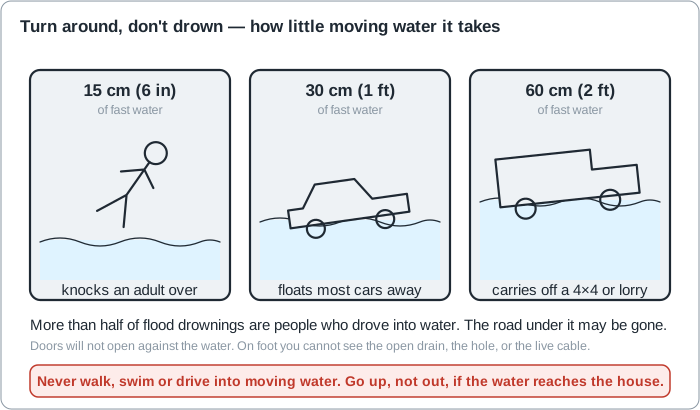
The numbers from the US National Weather Service are worth learning by heart, because nobody believes them until they have watched it happen:
- 15 centimetres (six inches) of fast-moving water will knock an adult off their feet.
- 30 centimetres (a foot) will float and carry away most cars.
- 60 centimetres (two feet) will carry away a four-wheel-drive or a lorry.
More than half of flood drownings happen in vehicles. People see water across the road, think it is shallow, and drive in. The road underneath may have gone. The car floats, turns, fills and sinks, and the doors will not open against the water. On foot you cannot see the drain with the cover gone, the washed-out hole, or the electric cable in the water.
The warning signs
- Heavy rain for more than a day, especially upstream, even if it is dry where you are.
- A river or canal rising fast, or turned brown and fast.
- Water backing up out of the drains.
- A warning on the radio for your river or district.
In Sri Lanka, the Disaster Management Centre puts out river-level and flood warnings, and its call centre is 117. The Irrigation Department reads the river gauges. Wherever you live, find out now who issues flood warnings and on which radio station, because in a long flood the phone may not work.
Before: the checklist
- Ask the neighbours who have lived there thirty years how high the water came last time, and where.
- Move valuables, documents and food up a floor or onto a high shelf before the rain, not during it.
- Fill clean water containers. Flood water fouls the wells and the mains.
- Know your route to high ground on foot, and walk it once with the children.
- Agree the trigger out loud: if the water reaches the lane, we go.
- Pack the bag (below) and put it by the door.
- Charge the phones, the power bank and the torches. Find the radio.
The bag by the door
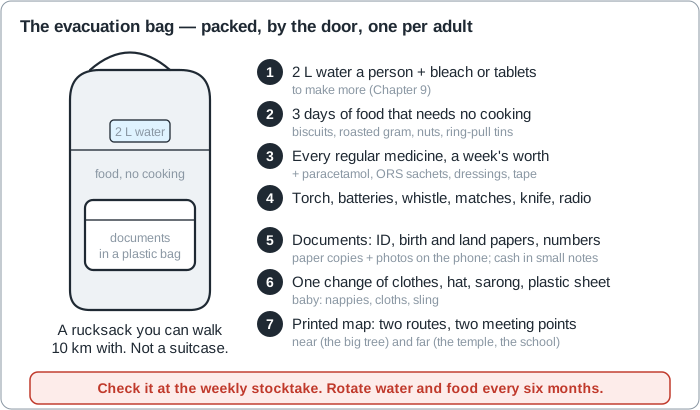
One per adult, a small one per child, packed and by the door the whole monsoon. Not a suitcase: a rucksack you can walk ten kilometres with.
- Water: two litres per person, and a way to make more (bleach in a small bottle, or tablets).
- Food for three days that needs no cooking: biscuits, roasted gram, nuts, dried fruit, tinned fish with a ring-pull.
- Every regular medicine, a week's worth at least, plus paracetamol, ORS sachets, a few dressings and tape.
- A torch and spare batteries, a whistle, matches in a bag, a knife, a small radio.
- Documents in a plastic bag: identity cards, birth certificates, land papers, bank details, a list of phone numbers, a photo of each child. Paper copies and photos on the phone.
- Cash in small notes.
- One change of clothes, a hat, a sarong or light blanket, and a plastic sheet or big bin bags against rain.
- For a baby: nappies, cloths, whatever they eat, and a sling.
- A printed map with two routes out and two meeting points marked: one near (the big tree at the corner), one further away (the temple, the school).
During
- Go early, on foot, by the route you planned, before the roads are rivers.
- If you are caught in the house, go up, not out: the upper floor, then the roof if you must, with the radio, water and a bright cloth to wave.
- Turn the electricity off at the main switch before the water reaches the sockets, but only if you can do it with dry hands, standing on something dry.
- Never touch anything electrical while standing in water.
After the water goes down
The water that is left is sewage, fuel, chemicals and the odd snake. Keep children out of it.
- Treat every drop you drink as dirty until the authorities say the supply is safe. Boil, bleach or sun; and if it smells of fuel, don't drink it at all.
- Wash hands with soap after touching anything the flood touched.
- Throw out any food the water reached, including tins with damaged seams. Wash undamaged tins in bleach water (one part bleach to ten of water) before opening.
- Don't go back into the house until the water has gone and you have looked at the walls and floors from outside. Watch for fallen wires.
- Dry the house fast, doors and windows open and everything wet out in the sun. Mould starts within two days and makes children with asthma ill.
- Tip out every tin, tyre and pot that has collected rain. Standing water breeds the daytime mosquito that carries dengue.
Diarrhoea, cholera and typhoid follow floods by a week or two. Keep ORS sachets in the house, or know the home rehydration recipe.
In the hills: landslides
The same monsoon rain brings landslides to Sri Lanka's central districts, Nepal and anywhere people have built on steep slopes. They come after days of heavy rain, usually at night. The rule: when the hill shows the signs, leave. Don't wait to see if it moves.
The signs are new cracks in the ground, walls or floors; doors or windows that suddenly stick; trees, posts or walls that start to tilt; new springs or wet patches, or a stream that suddenly stops or goes muddy; and a rumbling sound or small stones trickling down. Any two of these after heavy rain, and you leave that night. Go sideways, out of the path, never downhill in front of it.
Questions people ask
How deep does flood water have to be to be dangerous?
Very little. 15 cm (six inches) of fast-moving water will knock an adult off their feet. 30 cm (a foot) will float and carry away most cars. 60 cm (two feet) will carry away a four-wheel-drive or a lorry. These are the US National Weather Service figures.
What should be in a flood evacuation bag?
Two litres of water per person and bleach or tablets to make more; three days of food that needs no cooking; a week of every regular medicine plus paracetamol, ORS sachets and dressings; a torch, whistle, matches, knife and small radio; documents in a plastic bag; cash in small notes; a change of clothes and a plastic sheet; and a printed map with two routes and two meeting points.
Is tap or well water safe to drink after a flood?
Treat every drop as dirty until the authorities say the supply is safe. Boil it for one minute, or use two drops of plain bleach per litre and wait 30 minutes. If it smells of fuel or chemicals, don't drink it at all.
Who issues flood warnings in Sri Lanka?
The Disaster Management Centre puts out river-level, flood and landslide warnings, and its call centre is 117. The Irrigation Department reads the river gauges, and the National Building Research Organisation issues landslide warnings by district through the DMC.
Should I drive through flood water if it looks shallow?
No. More than half of flood drownings happen in vehicles. The road under the water may have gone, the car floats and turns, and the doors will not open against the water. Turn around, don't drown.
Flood depths are from the US National Weather Service; the landslide signs from the American Red Cross; the go-bag list from the Red Cross and Ready.gov. Full sources are at the back of the book.
