My neighbour Priya found out the power was gone the same way most people do. She reached for her phone in the dark, saw it had no signal, and assumed it was her phone. It was not her phone.
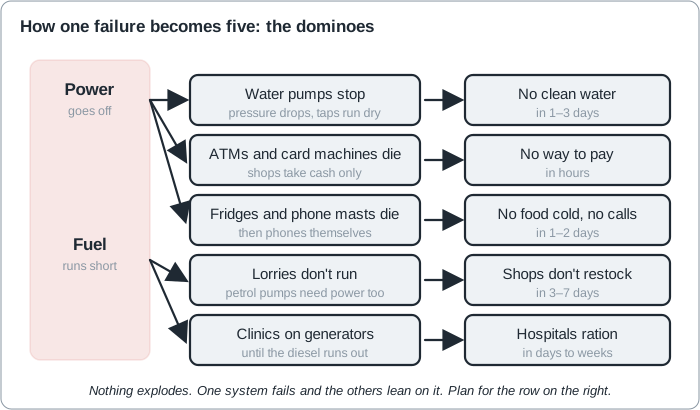
By lunchtime the shop on the corner was taking cash only, and nobody had any. By evening the water pressure was dropping, because the pumps that push water up the hill run on electricity too. By the second day the petrol station had a queue around the block and a hand-written sign that said NO CARD.
Nothing had exploded. A big piece of the grid had failed and nobody could say when it would be fixed. That is all it takes.
Stop, then think
When something big stops working, the natural reaction is to do something. Drive somewhere. Buy everything. Call everyone. Don't. Sit down for five minutes with a pen and paper and answer these:
- Is everyone in the house safe and unhurt?
- Is there any danger right now: fire, flooding, a cracked wall, a smell of gas?
- Is water still coming out of the tap?
- Is the power off just in our house, or in the whole street?
- Does the radio pick up anything?
- How much food and water do we actually have? Go and look. Don't guess.
- Does anyone need medicine that must be kept cold, or a machine that needs power?
Those seven answers tell you what to do next. Everything else can wait.
Water first, always
If water is still coming out of the tap, fill everything. Now, not later. Every clean pot, bottle, bucket and the bath. Put a lid or a cloth over each one. The water in the pipes right now is clean. The water that comes later, if the pumps lose pressure and dirty groundwater seeps in, might not be.
The number to remember is four litres per person per day. A family of four needs about fifty litres for three days, and a full bath holds more than that. If the tap is already dry, or you are not sure the water is clean, here is how to make water safe without power.
Keep the fridge shut
The food in the fridge is the first food you will lose, so it is the first food you eat, but only while it is still safe. Every time you open the door, cold air falls out onto the floor.
- A closed fridge keeps food cold for about four hours.
- A full, closed freezer keeps food frozen for about two days. A half-full one, about one day.
After that, meat, fish, milk, cooked rice and leftovers are a gamble. If they have been warmer than a cool room for more than two hours, throw them out. Do not taste to check; food that will make you sick usually tastes fine. Eat the fridge food first, then the freezer, then the cupboard. The rice, dhal, flour and tinned fish will still be there next week. The chicken will not.
Light that won't burn the house down
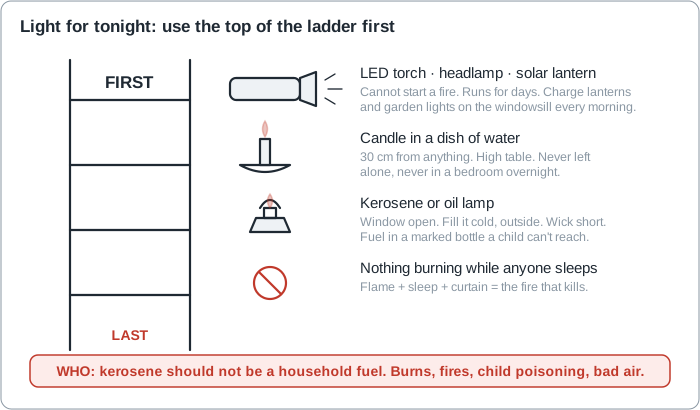
The first night is the one that frightens children. My rule for it: torch first, candle in a dish second, kerosene last, and nothing burning while you sleep.
- An LED torch per person, and a headlamp for whoever is cooking. Keep spare batteries out of the torches, because old batteries leak.
- A solar lantern charges on the windowsill all day and runs most of the evening.
- Garden solar lights, the little ones on sticks, make a free night-light for the stairs and the bathroom. Put them out in the day, bring them in at night.
- Candles last. Stand one in a dish of water or a jar, keep it 30 cm from anything that burns, and never leave the room with it lit. A candle burning while you sleep is a bet with your family's lives on the table.
Phones, radio and cash
Talk before the phones die. While there is any signal, send one short message: We are okay, we are at home, phones may go off. Agree one contact outside the area, and one place to meet if you are separated. Write the important numbers on paper. Most of us know about three by heart.
Make the phone last. Flight mode and the lowest screen brightness: two or three days instead of one. A 10,000 mAh power bank charges most phones two or three times. If you charge in a car, the engine runs outside, never in a garage.
Find the radio. When the internet goes, local radio stations keep broadcasting on generators. Listen at set times, say eight, midday and six, and switch off in between to save batteries.
Cash in small notes. Card machines and ATMs go with the power. The shops that stay open take cash, and they cannot change big notes. Keep enough for bread, candles, bus fares and a bag of rice for two weeks.
No generator, charcoal stove, barbecue, gas heater or running engine inside the house, a garage or a shed, even with the door open. A generator stands at least six metres from any window, door or vent. Carbon monoxide has no smell. If several people in the same room feel ill at the same time, or a headache goes away outside and comes back inside, get everyone out into the open air now.
Staying cool when the fan stops
In a hot country, heat is the bigger problem than the dark. Open the house at night and shut it by day. From an hour after sunset until an hour after dawn, open everything on both sides so the cooler air passes through; then close the curtains and shutters and keep the cool in. Put a mosquito net over the open windows.
A wet cloth on the back of the neck cools you faster than anything except a bath. Sleep low: a mat on a tiled floor beats a mattress by several degrees. Do the heavy work before nine and after four. Drink before you are thirsty, and check that the children and the old people are drinking, because both forget.
Your 72-hour checklist
Tick these off in this order. You don't need to finish them all on day one.
- Everyone safe and accounted for
- Water filled and covered
- Food counted; fridge plan agreed
- Family contact and meeting place agreed and written down
- Medicines and medical needs checked
- Toilet plan, if the water is off
- Light for tonight sorted: torch, candle in a dish of water, lamp
- Radio found; listening times set
- Cash counted; small notes separated
- A plan for the next seven days
Before it happens: the two-week shelf
Preparing is not panic-buying. It is knowing what to do and having a few cheap things in the right place. The book's version is one shelf, between you and the door, with two weeks of the food you already eat, water at four litres a day each, a battery radio, torches and spare batteries, a charged power bank, the medicines, cash in small notes and the numbers on paper.
Priya, by the way, was fine. She had read a list like this one a year before, and she had a bucket, a radio and a bag of rice. That was enough. It usually is.
Questions people ask
How long does food stay safe in the fridge during a power cut?
A closed fridge keeps food cold for about four hours. A full, closed freezer keeps food frozen for about two days, a half-full one about one day. After that, anything that should be cold and has been warmer than a cool room for more than two hours should be thrown out. Don't taste it to check.
How do I make my phone last longer in a blackout?
Switch it to flight mode and turn the screen to its lowest brightness. That way it lasts two or three days instead of one. A 10,000 mAh power bank from a known maker charges most phones two or three times; charge it to full every month.
Are candles safe in a power cut?
Only with rules. Stand the candle in a dish of water or inside a jar, keep it 30 cm from anything that burns, never leave the room with it lit, and never let it burn while anyone sleeps. Torches and solar lanterns first, candles last, and none at all if you have a toddler.
Can I run a generator indoors if I leave the door open?
No. A generator, charcoal stove or running engine inside the house, a garage or a shed can kill the people inside, even with the door or window open. A generator stands at least six metres from any window, door or vent, with the exhaust pointing away from the house.
How much water should I store for a power cut?
Four litres per person per day: two for drinking, two for cooking and washing. A family of four needs about fifty litres for three days, and about two hundred for two weeks. In a hot country, or with someone sick, plan for more.
The fridge and water numbers are from Ready.gov and the USDA; the candle rules from the US National Fire Protection Association. Full sources are at the back of the book.
