One shelf. One extra thing every time you shop. Food you already eat. Buy a headlamp first, a battery radio second and a bottle of plain bleach third. Store water in washed drinks bottles. Skip the "survival" packs, the freeze-dried meals and anything labelled tactical. In about three months you have two weeks covered, and no single week cost more than a few cups of tea.
Why everyone is talking about this
Updated 30 October 2026
Governments are now asking every household to keep supplies at home. The EU asked for at least 72 hours in March 2025, and the UK launched its Be Ready campaign on 22 October 2026, asking for three days. Money is the obvious obstacle: in the EU's 2024 Eurobarometer survey, almost four in ten people said they lacked the time or money to prepare.
The UK checklist's own answer is the right one: check your cupboards first, then pick up the missing items a few at a time during your normal shopping, to spread the cost. Here is how I do that, and what to skip.
Why two weeks, and not more
Most power cuts, storms, strikes and water failures are over within a few days. The bad ones run for a week or two. Agencies settle on similar numbers: 72 hours is the minimum the EU and the UK now ask for, Sweden says at least a week, and the US CDC says to try for two weeks of water.
Two weeks is also the biggest number most people will actually do. Tell someone to store a year of food and they store nothing, because it sounds like a job for a different kind of person. Tell them to put one extra bag of rice on a shelf this week, and they do it on Saturday.
The one-shelf method
I have set this up in rented rooms, and once in a two-room house with seven people in it. It works.
- Clear one shelfOr use a plastic crate under a bed. This is the emergency shelf, and nothing else goes on it.
- Add one thing each shopNot a trolley-load. One thing. A bag of rice this week, a bottle of bleach next week, a torch the week after, then tinned fish, batteries, lentils, oil, another bag of rice.
- Keep going for about three monthsBy then the shelf holds a fortnight for most households, and nothing you bought cost more than a takeaway.
- Eat it and replace itAnything that is normal food gets eaten and replaced: new at the back, old at the front. That way nothing goes out of date, and you never pay twice.
The rules of the shelf: nothing comes off it for an ordinary day (the batteries on the shelf are not for the TV remote), everyone in the house over ten knows where it is, and the water goes on the floor underneath, because water is heavy and shelves don't like it.
Store what you eat, eat what you store
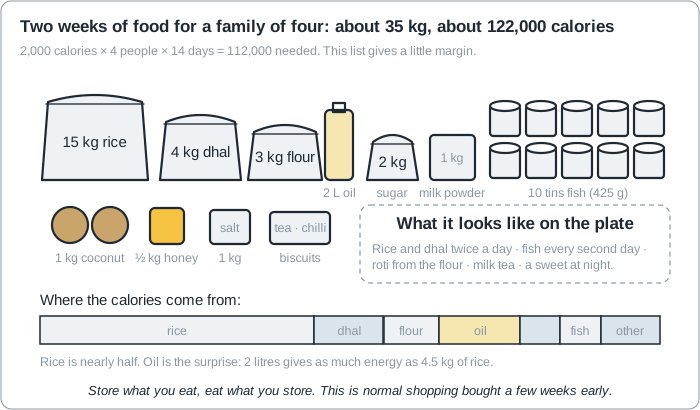
This one rule saves more money than any list. The food on your emergency shelf should be food that is already in your pan every week. Then nothing is wasted, nothing needs rotating on a spreadsheet, and nobody has to learn to cook something strange by torchlight.
An adult needs roughly 2,000 calories a day in an emergency. Cheap, dense, long-keeping food gets you there for very little:
| Food | Keeps (cool, dry, dark) | Note |
|---|---|---|
| White rice, pasta | 1–2 years | Longer if sealed and dry |
| Dried lentils and beans | 12 months+ | Old beans take longer to cook; lentils cook in about 20 minutes and save fuel |
| Sugar, salt, honey | Years | Keep salt dry |
| Tinned fish, beans, tomatoes, fruit | 12 months+ | Safe well past the date if the tin is sound |
| Flour | 6–8 months | Rotate faster in a warm kitchen |
| Vegetable oil | About 6 months unopened | Smell it; rancid oil smells of old paint |
| Dried milk powder | 3–5 years unopened | Buy small packets, not one big tin |
Those shelf lives come from US university extension services (Kansas State and Penn State), for a cupboard at about 21 °C.
Water costs almost nothing
Bottled water is convenient but you don't need to buy it. Wash out drinks bottles (only ones that held food or drink, never chemicals), rinse them with a teaspoon of plain bleach in a litre of water, fill them from the tap, and write the date on the lid. Replace every six months. A family of four needs about 50 litres for three days and about 200 for two weeks; the water guide has the full table.
If you cannot fit that much, store what you can and keep a bottle of plain, unscented bleach. At two drops per litre, one bottle treats thousands of litres. The water purification guide has the method.
The first three things to buy
If you have very little money and can buy one thing a week, this is the order I would buy in:
- A headlamp. Light with both hands free is the difference between cooking and spilling. Get one that takes ordinary AA or AAA batteries.
- A battery or wind-up radio. When the phone network goes, the radio is where the real news comes from. After the 2025 Iberian blackout, demand for battery radios in Portugal jumped by thousands of percent; buy yours while they are cheap and in stock.
- A bottle of plain bleach. It makes water safe and cleans what needs cleaning. The cheap own-brand one is the right one, as long as it is unscented.
Everything else you can find, borrow or do without for a fortnight. Those three you can't.
A cheap kit and a better kit
Prices change by country and month, so I give bands, not numbers. The cheap kit costs about a day's wages in total; the better kit about a week's. They do the same jobs. The better one lasts longer and fusses less.
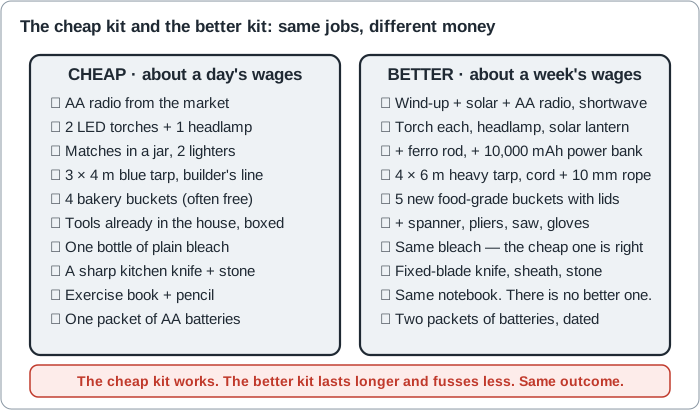
- Buckets: food-grade buckets with lids from a bakery, a deli or a takeaway are often free if you ask. They store water, become an emergency toilet, and carry anything.
- Tools: what is already in the house, gathered into one box.
- Notebook and pencil: any exercise book. There is no better notebook.
- Cash: a small amount in small notes, in an envelope with copies of your documents. Card machines stop when the power does.
What not to spend money on
- Pre-packed "72-hour survival bags". The bag is usually the best thing in it. Build your own and you spend less and get better.
- Freeze-dried "survival meals". Several times the price of the same calories in rice and lentils, your children won't eat them, and you'll never rotate them because you never cook them.
- Anything labelled "tactical". The word adds about half to the price and nothing to the use.
- Five-in-one gadgets. The radio-torch-siren-charger does each job badly, and when its one battery dies, five tools die.
- A generator you have no safe place for. It needs to stand outside, at least 6 metres from any window or door, and it needs fuel the petrol station may not have. If you don't know exactly why you need one, you don't.
- Big tins of anything. A 5 kg tin of milk powder is a bargain until you open it and have three months to use it.
If anyone in the house takes a daily medicine, that goes on the shelf first, before the rice. Ask your GP or pharmacist about keeping a little extra in hand; explain why. Food you can stretch. Insulin and heart tablets you can't.
Prepping on a budget
- One shelf. One extra thing each shop. Three months and you are done.
- Store what you eat, eat what you store. New at the back, old at the front.
- Buy first: headlamp, battery radio, plain bleach.
- Water in washed drinks bottles, dated, replaced every six months.
- Free buckets from a bakery. Tools you already own, in one box.
- Skip: survival bags, freeze-dried meals, "tactical" anything, big tins.
- Daily medicines on the shelf before the food.
Questions people ask
How do I start prepping with no money?
Start with what you have. Gather the torches, batteries, candles, tins and bottles already in the house onto one shelf. Fill washed drinks bottles with tap water and date them. That costs nothing. Then add one item each time you shop: a headlamp first, a radio second, a bottle of plain bleach third.
What is the cheapest way to store emergency water?
Tap water in washed food-grade bottles: old drinks bottles with screw caps, rinsed with a teaspoon of plain bleach in a litre of water, filled from the tap, dated, and replaced every six months. Never use bottles that held chemicals.
What food should I buy first for an emergency?
Food you already eat that keeps without a fridge: rice or pasta, lentils, tinned fish and beans, oil, sugar, salt, milk powder. Store what you eat and eat what you store, so nothing is wasted.
Are survival kits from online shops worth it?
Usually not. Pre-packed bags tend to be full of cheap filler: a whistle, a poncho, a torch that dies in a week. Build your own from your cupboards and you spend less and get better kit.
How much does a two-week emergency supply cost?
Prices vary too much by country to give one figure. In the book I use bands: a working kit costs about a day's wages in total, a better one about a week's. Spread over three months of normal shopping, most households hardly notice it.
Sources
- UK Government, Be Ready checklist (October 2026): beready.campaign.gov.uk/wp-content/uploads/sites/252/2026/10/Be-Ready-Checklist_English.pdf
- GOV.UK, Be Ready campaign launch (22 October 2026): www.gov.uk/government/news/households-encouraged-to-take-small-simple-steps-to-stay-prepared-in-an-emergency
- European Commission, Eurobarometer on disaster preparedness (30 September 2024): civil-protection-humanitarian-aid.ec.europa.eu/news-stories/news/europeans-believe-they-need-more-information-prepare-emergencies-recent-eurobarometer-survey-shows-2024-09-30_en
- CDC, Creating and storing an emergency water supply: www.cdc.gov/water-emergency/about/how-to-create-and-store-an-emergency-water-supply.html
- Krisinformation.se (Sweden), Water supply in a crisis: www.krisinformation.se/en/hazards-and-risks/home-preparedness/water-supply-in-a-crisis
- Lisboa Secreta, High demand for battery-operated radios (2 May 2025): lisboasecreta.co/en/high-demand-for-battery-operated-radios
