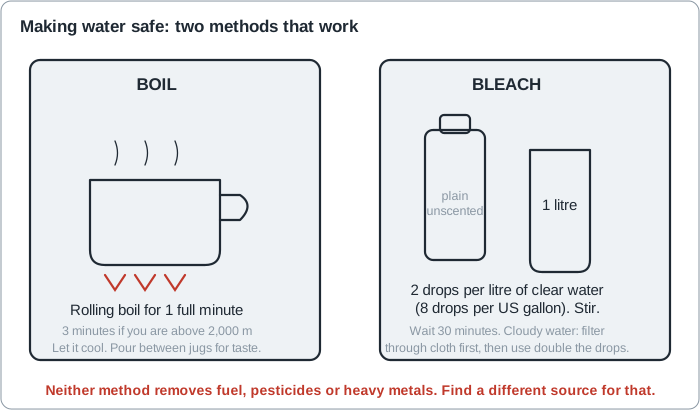
Boil it for 1 minute at a full rolling boil (3 minutes above 6,500 feet), let it cool, and use only that or bottled water for drinking, cooking, brushing teeth, ice, baby formula and your pets' bowls. Showering is fine if you don't swallow any. Hand-washing with soap and tap water is usually fine. Do this until the utility lifts the notice.
The text arrives from the city, or a neighbor knocks, or there's a paper notice on the door: boil your water. The tap still runs. The water still looks clear. Everyone in the house still reaches for the faucet out of habit, all day long.
A boil water notice means the utility can't promise the water is free of germs. A main has broken, the pressure dropped, a treatment step failed, or a test came back bad. The water may be perfectly fine. You treat it as if it isn't, because the germs that cause the trouble are invisible and the price of guessing wrong is a week of diarrhea, or worse for a baby.
How to boil water properly
- Let cloudy water settleIf it's cloudy, let it stand, then pour the clear water off the top, or filter it through a clean cloth or coffee filter first.
- Bring it to a rolling boilBig bubbles that keep coming even when you stir. Not the first small bubbles at the bottom of the pot.
- Keep it boiling 1 minuteThree minutes if you live above 6,500 feet (2,000 m), because water boils at a lower temperature up high. (The EPA uses 5,000 feet; I go with the more cautious number if you're in between.)
- Cool it with the lid onThen store it in clean, covered containers. Use a ladle or pour; don't dip cups in.
- Fix a flat tasteBoiled water tastes flat. Pour it back and forth between two clean containers, or add a pinch of salt per quart.
Make a day's worth at once and keep it in a labeled jug in the fridge. It's one job instead of twenty.
What you can and can't do
| Task | Under a boil notice |
|---|---|
| Drinking, coffee, tea | Boiled or bottled only |
| Cooking, washing fruit and vegetables | Boiled or bottled only |
| Brushing teeth | Boiled or bottled only |
| Ice | Throw out ice made during the notice; make new ice from boiled water. Don't use the fridge's ice or water dispenser. |
| Baby formula | The CDC prefers ready-to-use formula. Otherwise boiled and cooled water, or bottled. |
| Hand-washing | Tap water and soap are usually fine |
| Showers and baths | Fine for most people; don't swallow any. Sponge baths for babies and small children. |
| Dishwasher | Fine if it has a sanitizing cycle or a final rinse of at least 150°F |
| Dishes by hand | Wash, then soak 1 minute in 1 tsp unscented bleach per gallon of warm water; air-dry |
| Pets | Bottled or boiled-and-cooled water in their bowls |
The ones people forget: the toothbrush, the ice in the freezer tray, the salad rinsed under the tap, and the coffee maker filled straight from the faucet. Put a strip of tape over the kitchen faucet handle with "BOIL" written on it. It works better than reminding people.
If you can't boil: bleach
If the power is off as well, or you're short of fuel, plain unscented household bleach does the job against most germs. The EPA and CDC dose:
- Bleach at 6% (most regular bleach): 8 drops per gallon of clear water. About 2 drops per liter.
- Bleach at 8.25%: 6 drops per gallon. Check the label.
- Cloudy or very cold water: double it.
- Stir, cover, and wait 30 minutes. It should have a faint chlorine smell. If not, dose again and wait another 15 minutes.
Only plain bleach: no scented, splash-less or "with cleaner" kinds. And bleach is weaker than boiling against two tough germs, Cryptosporidium and Giardia, so if the notice names either of them, boil. The water purification guide has the full method, including the sunlight bottle method for when you have neither fuel nor bleach.
Some notices say do not drink or do not use. That usually means a chemical problem, not germs, and boiling won't help: neither boiling nor bleach removes fuel, chemicals, heavy metals or salt. Follow exactly what the utility says and use stored or bottled water until it lifts. This is when the water you stored pays for itself.
Who's most at risk
Babies and young children get diarrhea first and worst, and older people and anyone already ill dehydrate fastest. In those houses, be strict about every glass, toothbrush and bottle. If someone has a weak immune system, ask their doctor whether they need more than boiled water.
If someone does get diarrhea, the danger is dehydration. Keep them drinking, and use boiled or bottled water to make the home rehydration drink. Babies, small children and older people who stop drinking, can't keep fluids down, or have blood in their stool need a doctor.
When the notice lifts
The utility will tell you when it's over, and usually how to flush your pipes. Follow its steps exactly; they differ from place to place. Then:
- Throw out any ice made during the notice
- Flush the fridge's ice and water dispenser the way its manual says, and change any filter cartridges
- Refill your stored water if you used it, and date the containers
- Take the tape off the faucet
Boil water notice
- Rolling boil 1 minute. 3 minutes above 6,500 ft. Cool, cover, label.
- Boiled or bottled: drinking, cooking, teeth, ice, formula, pets.
- Showers OK, don't swallow. Babies: sponge bath. Hands: soap and tap are fine.
- Dishwasher with sanitize cycle OK. By hand: soak 1 minute in 1 tsp bleach per gallon.
- No fuel? Plain bleach, 8 drops per gallon, 30 minutes. Double if cloudy.
- "Do not drink" means chemicals: boiling won't help. Use stored water.
Questions people ask
Can I shower during a boil water notice?
Yes, for most people, as long as you don't swallow the water. The CDC suggests sponge baths for babies and young children, who are more likely to swallow water in the bath.
Can I brush my teeth with tap water during a boil water advisory?
No. Use boiled and cooled water or bottled water to brush your teeth and rinse your mouth.
Is it safe to wash dishes during a boil water notice?
In a dishwasher, yes, if it has a sanitizing cycle or a final rinse of at least 150°F. By hand, wash as usual, then soak the dishes for 1 minute in 1 teaspoon of unscented bleach per gallon of warm water and let them air-dry, as the CDC describes.
Does a water filter make tap water safe during a boil notice?
Don't rely on it. The CDC says to boil the water even if you filter it.
Can I make baby formula with boiled tap water during a notice?
The CDC prefers ready-to-use formula during an advisory, because it needs no water at all. If you must mix powder, use bottled water or tap water brought to a rolling boil for 1 minute and cooled with the lid on. Wash bottles and nipples in boiled water too, and keep breastfeeding if you are; breast milk needs no water and nothing can get into it on the way.
Can I use the ice and water from my refrigerator dispenser?
No. The CDC says not to use water or ice from refrigerator dispensers during an advisory. Throw out ice made during the notice. When it lifts, follow your utility's instructions and the fridge manual to flush the line.
This page is information, not medical advice. Follow your water utility's notice where it differs from this page. The boiling and bleach figures are the CDC's and the US EPA's.
Sources
- CDC, Drinking water advisories: an overview: www.cdc.gov/water-emergency/about/drinking-water-advisories-an-overview.html
- CDC, Making water safe in an emergency: www.cdc.gov/water-emergency/about/index.html
- US EPA, Emergency disinfection of drinking water: www.epa.gov/ground-water-and-drinking-water/emergency-disinfection-drinking-water
