Fridge: about 4 hours with the door closed. Full freezer: about 48 hours. Half-full freezer: about 24 hours. The line is 40°F: perishable food that has been above it for 2 hours or more gets thrown out. Never taste food to check. When in doubt, throw it out.
The power goes off at dinner time. Everyone's first instinct is to open the fridge and look. Don't. Every time the door opens, the cold falls out onto the floor and the clock on everything inside speeds up.
Those numbers above are the CDC's, and they assume the door stays shut. Most of what you can do to save your food happens in the first ten minutes, before anyone has worked out how long the outage will last.
The first ten minutes
- Shut the doors and leave them shutTape a note on the fridge if you have kids. Decide what you need for the next meal, get it out in one go, and close it.
- Write down the timeOn paper, on the fridge door. In two days nobody will remember whether the power went at five or at eight, and the whole decision rests on that number.
- Check the thermometersThe CDC recommends an appliance thermometer in both the fridge (40°F or below) and the freezer (0°F or below). They cost a few dollars. Without one, you are guessing.
- Get the cooler readyFind the cooler and any frozen gel packs. If the outage looks long, buy block ice or dry ice early, before everyone else in town does.
What to eat first
People open the cans first, because cans feel like emergency food. That's backwards. The cans will be fine in a month. Eat in this order:
- The fridge, in the first 4 hours. Milk, leftovers, cooked food, anything opened. Eat it, cook it, or move it to a cooler with ice.
- The freezer, over the next one to two days. Keep the door shut. As meat and fish begin to thaw, cook them and eat them. Cooked food in a cooler with ice keeps another day.
- Fresh food on the counter: bread, bananas, cut fruit, vegetables.
- Food that needs no cooking, if fuel is short: crackers, peanut butter, cereal.
- Then the dry staples: rice, pasta, oats, beans.
- The cans last. They don't care how long it takes.
One more habit from long outages: cook and eat the main meal in the middle of the day, while there's light and while you can see what you're doing, and have something cold in the evening.
After 4 hours: the cooler
If the power isn't back after 4 hours, the CDC says move perishable food from the fridge into a cooler with ice or frozen gel packs, so it stays at 40°F or below. Put a thermometer in the cooler too. Keep it in the coolest, shadiest place you have and open it as rarely as the fridge.
A full freezer is its own ice box. Leave it shut. If it's half empty, push the food together, and next time fill the gaps with jugs of frozen water: they keep the freezer cold longer, and they become drinking water when they thaw.
Keep or throw out
When the power comes back, check the thermometers before anything else.
- Fridge still at 40°F or below: the food is fine.
- Fridge was off more than 4 hours with no cold source: the CDC says throw out the perishables: meat, fish, eggs, milk, cut fruit and vegetables, and leftovers.
- Freezer food that still has ice crystals, or is at 40°F or below: the CDC says you can safely refreeze it or cook it.
- Thawed and above 40°F for 2 hours or more: throw it out.
- Anything with an odd smell, color or texture: throw it out, whatever the clock says.
The USDA's FoodSafety.gov site has a keep-or-discard chart that goes item by item, condiments and hard cheeses included. Print it and tape it inside a kitchen cabinet door, because when you need it the internet may be down.
The bacteria that cause food poisoning usually don't change how food smells or looks. Tasting "just a little" to check is how people get sick. Go by the clock and the thermometer. Throwing out a $10 pack of chicken is cheaper than a week of food poisoning with no running water.
Cans: the three that can kill
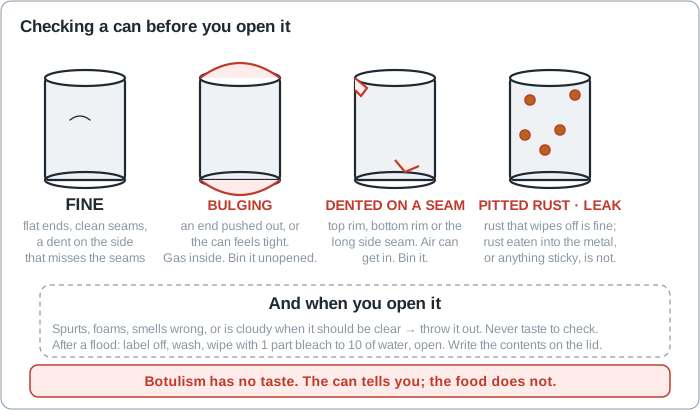
Canned food is the safest food in the house, with three exceptions:
- Bulging or swollen at either end. Something is growing inside. Throw it away unopened.
- Dented on a seam, the top rim, bottom rim or side seam. A dent in the middle of the side is usually fine.
- Rusted through or leaking. Surface rust that wipes off is fine. Pitted metal or anything sticky is not.
And whatever the can looks like: if the food spurts or foams when you open it, smells wrong, or looks moldy, throw it out. If your cans have been in floodwater, the CDC says take off the labels, wash and sanitize them before opening, and relabel them with a marker.
Before the next outage
- An appliance thermometer in the fridge and the freezer
- Jugs of water frozen in the freezer's empty spaces
- A cooler and gel packs where you can find them in the dark
- A two-week shelf of food that needs no fridge: rice, pasta, oats, beans, canned fish, peanut butter, powdered milk
- A manual can opener
- A printed copy of the keep-or-discard chart
- A plan for any medicine that must stay cold; ask your pharmacist now
If the outage comes with a winter storm, the winter storm checklist covers the rest of the house. If you're thinking of a generator to run the freezer, read generator safety and carbon monoxide first. It's the one piece of kit in an outage that regularly kills families.
Fridge off
- Doors shut. Write down the time the power went.
- Fridge 4 hours. Full freezer 48. Half-full 24.
- After 4 hours: perishables to a cooler with ice, at 40°F or below.
- Eat in order: fridge, freezer, fresh, no-cook, dry staples, cans last.
- Ice crystals or 40°F or below: refreeze or cook. Above 40°F for 2 hours: out.
- Never taste to check. When in doubt, throw it out.
- Bulging, seam-dented or rusted-through cans: out, unopened.
Questions people ask
How long will food last in a freezer without power?
About 48 hours in a full freezer and about 24 hours in a half-full one, if you keep the door closed. A full freezer stays cold longer because the frozen food keeps itself cold, so filling empty space with frozen water bottles helps.
Can I refreeze food that has thawed?
Yes, if it still has ice crystals in it or is at 40°F or below, according to the CDC. If it has fully thawed and been above 40°F for two hours or more, throw it out.
How do I know if my fridge food went above 40°F?
Keep an appliance thermometer in the fridge and the freezer, as the CDC recommends, and write down the time the power went off. If the fridge reads 40°F or below when the power returns, the food is fine. If you have no thermometer and the power was off for more than 4 hours, treat the perishables as unsafe.
What about medicine that needs refrigeration?
Ready.gov says to throw out refrigerated medicine after a power outage of more than a day unless the label says otherwise. If a life-saving medicine like insulin is affected, call your pharmacist or doctor right away and ask before you discard or use it.
Can I tell by smell if food is still good?
No. The CDC says never taste food to check whether it's safe. The bacteria that make you sick often don't change the smell or look of food. Go by time and temperature, and when in doubt, throw it out.
This page is information, not medical advice. The times and temperatures are the CDC's and Ready.gov's. If someone in the house has vomiting or diarrhea after eating, see the home rehydration drink and the signs that mean a clinic.
Sources
- CDC, Keep food safe after a disaster or emergency: www.cdc.gov/food-safety/foods/keep-food-safe-after-emergency.html
- Ready.gov (FEMA), Power outages: www.ready.gov/power-outages
