Shut the house by day, open it at night. Close curtains and blinds on the sunny side from mid-morning. From an hour after sunset until an hour after dawn, open windows on both sides so cooler air runs through. Put water on your skin: a wet cloth on the neck, cool feet in a bowl, a damp sheet at night. Drink before you are thirsty. And check on anyone old or ill who lives alone, twice a day.
Why this matters more every summer
Updated 30 October 2026
Europe's summer of 2026 was its third warmest on record, and western Europe's warmest ever, beating 2003, according to the EU's Copernicus climate service. The first big heatwave hit western Europe in late May. By the end of the season about half the continent, 52%, had reached "very strong" heat stress, meaning it felt like 38 °C or more.
In June the WHO's Europe office said heat had killed more than 200,000 people across the EU and its associated countries in just four years, and that most of those deaths were entirely preventable. Its advice for households was plain: blinds and curtains closed by day, windows open at night, drink before you are thirsty, stay out of the midday sun, and check on older neighbours and relatives. "A phone call costs nothing and can save a life."
None of that needs air conditioning. Here is how to do it well.
Keep the heat out of the house
A house heats up from the sun on its glass, walls and roof. Stop the sun before it gets in and you have won most of the fight.
- Shade outside the glass if you can. Shutters, an awning or an outside blind stop the heat before it reaches the window. Curtains and blinds inside still help; close them on every sunny window.
- Close the sunny side first. East-facing rooms in the morning, south and west in the afternoon. Shut them before the sun reaches them, not after the room is already hot.
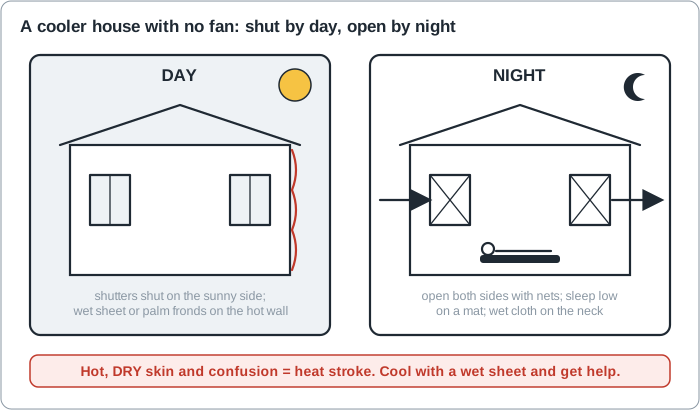
- Shade the hot wall. A sheet, a sun sail or a tarp hung outside on the sunny side, with air behind it, keeps the sun off the wall itself.
- Switch off what makes heat. Ovens, tumble dryers, old bulbs, a computer left on. Cook once, early, and eat cold food later.
- Top-floor flats are the hottest homes in any city. Heat rises through the building and the roof bakes. If that is you, plan where you will spend the worst afternoons: a cooler room downstairs at a friend's, a library, a church, a shopping centre.
Open at night, shut by day
This is the opposite of what most people do. They open the windows at noon because the room feels stuffy, and the hot air pours in.
Do it the other way round. From an hour after sunset, when the air outside is cooler than the air inside, open everything you safely can, on both sides of the house, so air moves through. Leave it open until an hour or so after dawn. Then, as the day warms, shut the windows and draw the curtains and keep the night's cool in. Check the outdoor thermometer if you have one: when outside is hotter than inside, the windows stay shut.
Cool the body, not the room
When the house is hot anyway, work on the person.
- A wet cloth on the back of the neck or across the forehead cools you faster than anything except a cool shower. Re-wet it every half hour.
- Feet in a bowl of cool water while you sit. A damp T-shirt does the same over a bigger area.
- Sleep low. Hot air rises. A mattress on the floor of the coolest room beats the bed upstairs by a few degrees. A damp sheet over you, with a breeze, is the nearest thing to air conditioning without power.
- Light, loose, pale clothes, and a wide hat outside.
- Do the heavy jobs early and late. The NHS says stay in the shade between 11am and 3pm. Shopping, gardening, carrying and exercise go at the start and end of the day; in the middle of it, sit still in the coolest place you have.
About fans: a fan helps while the air is cooler than your skin, because it moves sweat off you. The NHS says electric fans can help when the temperature is below 35 °C (95 °F). Above that, and in a power cut when there is no fan anyway, water on the skin does the work.
Drink before you are thirsty
A cup of water every hour you are awake is my rule in a heatwave, and more if you are working or sweating hard. If you are sweating a lot for hours, a rehydration drink puts back the salt as well: the WHO sugar and salt recipe takes two minutes to make. The NHS says avoid alcohol, caffeine and hot drinks; the WHO adds sugary ones.
Older people feel thirst late, and children forget. Put a jug and a glass where they can see them and fill the glass yourself. If the power is off for long, your stored water goes faster in heat than in any other emergency; the water-per-person numbers are a floor in hot weather, not a ceiling.
Who gets into trouble first
Heat kills quietly, indoors. The classic case is an older person alone in a top-floor flat with the windows shut, not drinking because they are not thirsty, who slips into heatstroke over a day or two. The people most at risk:
- People aged 65 and over, especially those who live alone
- Babies and children aged 5 and under, and pregnant women
- Anyone with a serious long-term condition: heart or breathing problems, dementia, diabetes, kidney disease
- People taking several medicines, or medicines that make heat harder to handle (ask the pharmacist; don't stop taking them)
- Anyone already ill or dehydrated, anyone homeless, and anyone working outside or doing manual work
If you know someone on that list, call or knock twice a day while the heat lasts: once in the morning and once in the late afternoon, when the house is at its hottest. Check that the room they are in is cool, that there is water by the chair, and that they are drinking it. Never leave a child or an animal in a parked car, not for a minute.
Heat exhaustion or heatstroke?
Two stages of the same thing. The line between them is the line between a bad afternoon and an emergency.
| Heat exhaustion | Heatstroke | |
|---|---|---|
| Signs | Tired, dizzy, headache, feeling sick, cramps, heavy sweating, pale clammy skin | Not better after 30 minutes of cooling; very hot skin, often not sweating; fast breathing; confused, fitting or unconscious |
| Do | Move to a cool place, lie down with feet raised, remove outer clothes, sip water or a rehydration drink, sponge and fan, cool packs in armpits and on neck | Call the emergency number (112 anywhere in the EU, 999 in the UK). Keep cooling hard: wet sheet, pour water, fan |
| Expect | Better within 30 minutes | A medical emergency |
The rule I teach: sweating and miserable, cool them and watch the clock. Hot, confused or not making sense, cool them and call for help. Don't give drinks to someone who is confused or not fully awake; they can choke.
Heat and blackouts arrive together, because air conditioners push the grid to its limit. No fans, no fridge, maybe no water pressure. Fill bottles while the tap runs, keep the fridge shut, and look after the oldest person first. The Iberian blackout showed how fast a city stops when the grid does.
Heatwave, no air con
- Sunny side shut by day. Open both sides at night, shut again after dawn.
- Water on the skin: wet cloth on the neck, feet in a bowl, damp sheet at night.
- Sleep low, in the coolest room. Shade from 11 to 3; heavy jobs early and late.
- A cup of water an hour. Rehydration drink if sweating for hours.
- Older people alone: a call or a knock twice a day.
- Sweating and miserable: cool, better in 30 minutes. Hot and confused: cool and call 112, or 999 in the UK.
Questions people ask
How can I cool down a room without air conditioning?
Keep the sun off the glass: close curtains, blinds and shutters on the sunny side from morning, and shade the hot wall outside if you can. Switch off anything that makes heat. Then, once the air outside is cooler than inside, usually from an hour after sunset, open windows on both sides of the house so air runs through, and shut them again after dawn.
Do fans work in a heatwave?
Up to a point. The NHS says electric fans can help if the temperature is below 35 °C. Above that a fan blows hot air at you. Water on the skin, from a wet cloth, a cool shower or feet in a bowl, works at any temperature and needs no power.
Should I keep windows open or closed in a heatwave?
Closed, with curtains drawn, during the hot part of the day. Open at night when it is cooler outside than in. The NHS and the WHO both give this advice.
How do I keep cool at night without air con?
Sleep in the coolest room, low down, because hot air rises. Air the room from the evening, use a single thin sheet or a damp one, cool your feet and the back of your neck with water before bed, and keep a glass of water by the bed.
What are the signs of heatstroke?
A very high temperature, hot skin that may not be sweating, fast breathing and heartbeat, confusion, fits or loss of consciousness. The NHS says call 999 for heatstroke, and also if someone with heat exhaustion is not better after 30 minutes of cooling and fluids. In the EU, call 112.
This page is information, not medical advice. If you are worried about someone in the heat, call your doctor, NHS 111 in the UK, or the emergency number. The heat-illness signs follow the NHS and the WHO; the house-cooling advice is from the book.
Sources
- Copernicus, Record heat stress and low river flows marked Europe's 2026 summer (2 October 2026): climate.copernicus.eu/copernicus-record-heat-stress-and-low-river-flows-marked-europes-2026-summer
- WHO Europe, Statement: Europe lost 200 000 people to heat in 4 years (11 June 2026): www.who.int/europe/news/item/11-06-2026-statement---europe-lost-200-000-people-to-heat-in-4-years-yet-nearly-all-of-them-were-preventable
- WHO Europe, Statement: current heatwaves are a dress rehearsal (30 June 2026): www.who.int/europe/news/item/30-06-2026-statement---get-prepared--current-european-region-heatwaves-are-a-dress-rehearsal
- NHS, Heatwave: how to cope in hot weather: www.nhs.uk/live-well/seasonal-health/heatwave-how-to-cope-in-hot-weather
- NHS, Heat exhaustion and heatstroke: www.nhs.uk/conditions/heat-exhaustion-heatstroke
- European Commission, 112: the European emergency number: digital-strategy.ec.europa.eu/en/policies/112
